
Army, Rangers to launch joint operation against dacoits in Sindh’s ‘katcha area’

KARACHI: Sindh Caretaker Chief Minister Justice (retd) Maqbool Baqar on Friday greenlighted the Pakistan Army and Sindh Rangers’ comprehensive joint operation against dacoits in the province’s Katcha (riverine) area.

Chairing the 28th meeting of the provincial APEX committee in Karachi, the interim CM approved a joint comprehensive operation against dacoits in the area of Sukkur and Larkana divisions.

During the meeting Justice (retd) Baqar expressed dismay over authorities’ failure to neutralise and tackle a handful of outlaws in the Katcha area bringing the construction of the Ghotki-Kashmore bridge to a halt.

The huddle was attended by provincial ministers and security officials including Caretaker Sindh Home Minister Brigadier (retd) Haris Nawaz, Corps Commander Karachi Lieutenant (Lt) General Babar Iftikhar, Sindh Inspector General Police (IGP) Riffat Mukhtar, Director General (DG) Sindh Rangers Major General Azhar Waqas, Chief Secretary Dr Fakhre Alam and others.

Briefing the session on the situation in the riverine area, IGP Mukhtar apprised that around 50 to 60 dacoits were operating in the Katcha area whereas the rest were their tribesmen living there.

The IGP accentuated that the police have prepared the list of the wanted dacoits and that eight forward base camps were being established with 50 personnel each in the Katcha area of the four districts – six each in Ghotki and Kashmore, four in Shikarpur and two in Sukkur.

Meanwhile, 400 police check posts were being established of which 210 have been constructed with a deployment of 3,200 policemen, IGP Mukhtar said.

Briefing the meeting on the prevailing kidnapping for ransom menace, the IGP said that a total of 220 persons have been kidnapped in 2023 so far, of which 128 were kidnapped in Larkana, 46 in Sukkur, 42 in Karachi three in Hyderabad and one in Shaheed Benazirabad.

Out of the 220 kidnapped individuals, 210 have been recovered, he added.

Responding to the requirement of sophisticated military-grade weapons — such as sniper rifles, grenade launchers, mortars, night vision devices, and drones — Corp Commander Lt General Babar Iftikhar Babar apprised that the Ministries of Defence and Interior have already issued the required clearance for the procurement of weapons.

The development comes as the authorities earlier this week, had seized a huge cache of military-grade weapons in Ghotki.

Lt General Babar Iftikhar also directed Sindh Rangers to provide security for the people working at the construction site of Ghotki-Kashmore bridge.

Karachi street crime

The APEX committee huddle also discussed increasing street crime in the metropolis with Additional IG (AIG) Karachi Khadim Rind briefing the committee on the overall crime situation in the city.

The AIG apprised the meeting that 61,098 street crime cases were reported in the city so far (September 17 2023).

District East topped the chart with 17,570 street crime cases followed by District Central’s 14,648, and District Korangi’s 10,731 cases.

Meanwhile, 6,551 street crime cases were reported in District West, 3,193 in Malir, 3,174 in Keamari and 2,741 in District South

The committee was also told that 411 people were n killed in various street crime incidents in the metropolis.

The chief minister directed the police to come up with a comprehensive strategy to curb the street crime menace.

Furthermore, it was also decided that a joint operation by police and Rangers would be launched against street criminals and drug mafia operating in the city.

The committee also approved frequent combing operations in slum areas, snap-checking duration peak hours, surveillance and action against bailed-out criminals, repeat offenders, narcotic peddlers, and absconders.

Additionally, the huddle agreed on increasing surveillance through CCTV camera networks and command and control centres with the chief minister constituting a committee including provincial caretaker minister Omar Soomro with Sindh Planning and Development Department Chairman Shakeel Mangijo, Home Secretary Iqbal Memon, and DG Safe City Authority Aijaz Shaikh to submit a report on the implementation of the Safe City Project.

Action to be taken against illegal hydrants

The APEX committee was also briefed by Sindh DG Rangers General Azhar Waqas who apprised that 27 operations against illegal hydrants in various districts across Karachi.

27 illegal hydrants were sealed and 43 individuals were arrested during the raids, the meeting was told.

Army chief discusses defence, security affairs with Saudi counterpart

Chief of Army Staff (COAS) General Asim Munir discussed various bilateral issues including security and defence, in a meeting with his Saudi counterpart General Fayyadh Bin Hamed Al Ruwaili, the Inter-Services Public Relations (ISPR) said on Friday.

“Chief of General Staff Armed Forces of Kingdom of Saudi Arabia General Fayyadh Bin Hamed Al Ruwaili, led by a high-powered military delegation, called on Chief of Army Staff General Syed Asim Munir,” the military’s media wing said in a brief statement about the meeting.

On the occasion, the two commanders deliberated upon various areas of mutual interest and bilateral cooperation including defence and security matters.

The ISPR further added that earlier, the delegation also called on Chairman Joint Chiefs of Staff Committee (CJCSC) General Sahir Shamshad Mirza at the Joint Staff Headquarters, Rawalpindi.

It may be noted that Gen Munir told the Pakistani businessmen earlier this month about a $25 billion investment assured by Saudi Arabia, which had assured Pakistan of investment in IT, minerals, agriculture and defence under the Special Investment Facilitation Council (SIFC).

The COAS told the business community that Saudi Crown Prince Mohammad Bin Salman had agreed that of the $25 billion, $10 billion would be kept in the State Bank of Pakistan (SBP). This will be returned in the form of the Pakistani rupee or goods so that the foreign exchange could increase.

The army chief had also said that the crown prince has identified bureaucracy obstacles to investment and called for removing them, adding that they have Special Investment Facilitation Council (SIFC) to do away with the bureaucratic hurdles.

In July, former PM Shehbaz constituted the SIFC — comprising army chief and senior federal ministers — to provide an impetus to the government’s efforts for economic revival through investments and developmental projects.

After caretaker Prime Minister Anwaar-ul-Haq Kakar took the reins of the country, he announced that Saudi Arabia along with other Middle-Eastern countries would invest in projects worth $25 billion each in a span of two to five years.

Three Indian martial arts athletes have been seemingly caught up in a row between India and China over a long-standing border dispute.

The women are from the Indian state of Arunachal Pradesh – which China claims as its own territory.

They are in a group due to compete in the Asian Games, which open in the Chinese city of Hangzhou on Saturday.

But India said they were prevented from travelling and accused Beijing of denying them the proper accreditation.

China has denied this, saying all athletes with legal documents are welcome.

According to Indian media, the three wushu athletes – Nyeman Wangsu, Onilu Tega and Mepung Lamgu – were left behind after their documents could not be downloaded.

None of the team’s other members reportedly experienced any problems.

In a statement, India’s foreign ministry said China had “discriminated” against the athletes in a “targeted and pre-meditated manner”.

“India firmly rejects differential treatment of Indian citizens on the basis of domicile or ethnicity,” it reads.

“Arunachal Pradesh was, is and always will remain an integral and inalienable part of India.”

India added it had launched a “strong protest” over the issue and said the country’s sports minister had cancelled his trip to the Games.

An official for the Olympic Council of Asia (OCA) said China had issued the women visas but they had refused to accept them as they were different to the visas given to the rest of the Indian delegation.

“According to the Chinese government regulations, we have the right to give them a different kind of visa,” said Wei Jizhong.

Another OCA official said the organising committee for the Games was working to find a solution so the women could compete.


It is not the first time there has been a dispute over documentation.

The same athletes did not compete at the World University Games in another Chinese city, Chengdu, in July because they were given stapled visas.

These visas are regarded as an indication that China does not accept India’s territorial claim over Arunachal Pradesh.

Beijing instead claims the area as “South Tibet” – which India firmly rejects. India claims the Aksai Chin plateau in the Himalayas, which is controlled by China.

A spokeswoman for China’s foreign ministry said on Friday that Beijing “welcomes athletes from each country to come to Hangzhou with legal documents to participate in the Asian Games.”

“The Chinese government has never recognised the so-called Arunachal Pradesh. The south Tibetan region is part of China’s territory.”

The source of the tension between the neighbours is a disputed 3,440km (2,100 mile) de facto border along the Himalayas – called the Line of Actual Control, or LAC – which is poorly demarcated. The presence of rivers, lakes and snow caps means the line can shift in places.

India also claims the Aksai Chin plateau in the Himalayas, which is controlled by China.

Soldiers on either side come face to face at many points, which can spark tensions – the last time being in December when Indian and Chinese troops clashed along the border in the town of Tawang.

The Asian Games are the continent’s biggest sporting event and are held every four years. They were due to be held in 2022 but were delayed due to the Covid pandemic.

The head of Sudan’s army has told the BBC he is willing to talk to the commander of rebel forces whom he is battling for control of the country.

General Abdel Fattah al-Burhan said he was ready in principle to sit down with Mohamed Hamdan Dagalo, leader of the Rapid Support Forces (RSF).

The two men have been fighting a brutal internal war since April, which the UN says has left more 5,000 people dead.

It says that more than five million people have been displaced.

Gen Burhan – who seized power in a coup in 2021 – was speaking to the BBC in a rare interview after addressing the UN General Assembly in New York.

He heads the Sudanese Armed Forces (SAF) and is on a global diplomatic tour seeking international support and some kind of legitimacy for his leadership, despite his failure to hand power to civilian authorities.

The general denied his forces were targeting civilians – despite the UN and charities saying there is evidence they are launching indiscriminate air strikes on residential areas.

He said he was confident of victory, but admitted he had been forced to relocate his headquarters to Port Sudan because the fighting in the capital Khartoum had made it impossible for government to continue.


Gen Dagalo (centre) also says he is ready for political talks

Gen Burhan said he would sit down with Gen Dagalo – known as Hemedti – as long as he abided by commitments to protect civilians, made by both sides during talks in Jeddah, Saudi Arabia, in May.

“We are ready to engage in negotiations,” Gen Burhan said.

“If the leadership of these mutinous forces has the desire to return to its senses and pull its troops out of the residential areas and return to its barracks, then we will sit with any of them… Whenever he commits to what was agreed in Jeddah, we will sit to resolve this problem.”

In a video message this week, Hemedti also claimed he was ready for political talks.

Both generals have talked about ceasefires before – but so far that has not led to any lessening in the fighting.

Gen Burhan denied Sudan would become a failed state like Somalia – or a divided country like Libya.

“Sudan will remain united. Sudan will remain a state intact, not a failed state. We don’t want what happened in the other countries you mentioned. The Sudanese people are now united behind one cause, ending this mutiny peacefully or by combat,” he said.

The UN has said that neither warring party appears close to a decisive military victory.

Gen Burhan said he was “definitely” confident of defeating the RSF. But he admitted the fighting had forced him out of the capital.

“In Khartoum, diplomatic missions, the ministries and all government organs cannot carry out their duties as normal,” he said. “Because it is a war zone, there are snipers and military operations taking place. That is why no entity can now work in Khartoum.”

There is widespread evidence that civilians in Sudan are dying in indiscriminate air strikes carried out by Gen Burhan’s forces in residential areas, particularly in Khartoum. But the general denied civilians were being deliberately targeted.

“This is not correct,” he said.

“There are fabrications of some stories by the rebel forces, they bomb civilians and film it as if it was the armed forces. We are professional forces, we work with precision and select our targets in areas where only the enemy is present. We don’t bomb civilians and we don’t target residential areas.”

The capital Khartoum has been devastated by fierce fighting

The former UN special representative to Sudan, Volker Perthes, told the Security Council earlier this month that “often indiscriminate aerial bombing is conducted by those who have an air force, which is the SAF”.

The war in Sudan has reignited bitter tribal conflict, especially in Darfur in the west, where the RSF and supportive militias have been accused of mass killings, rape and torture.

Five killed, over 100 injured as fire engulfs Taiwan factory

According to reports, the blaze erupted on Friday night at the factory in Pingtung county and raged overnight.

Rescuers officials stated that five people are still missing, including four factory workers and one firefighter.

Tragically, among the deceased, three were firefighters.

As the news of this tragic incident reverberated across the island nation of Taiwan, President Tsai Ing-wen stepped forward to express heartfelt condolences to the bereaved families.

She pledged to visit Pingtung and provide solace to those directly affected by the incident.

The cause of the fire is yet to be determined.

Former Prime Minister Boris Johnson has urged the government against building a “mutilated” version of HS2.

He said suggestions the high-speed rail link that began construction under his premiership could be scaled back were “Treasury-driven nonsense”.

Last week, the government refused to guarantee HS2 would continue between Birmingham and Manchester.

It comes as more than 80 companies and business leaders seek clarity over the commitment to HS2.

In a letter to the government, they expressed “deep concern” over “the constant uncertainty” that “plagues” the project.

However, a government spokesperson said on Friday that “our focus remains on delivering” HS2.

It was under Mr Johnson’s government that HS2 – intended to link London, the Midlands and the north of England – was given the green light to start construction in 2020.

The first part of HS2, between west London and Birmingham, is in mid-construction, and £2.3bn has already been put towards the next sections including on acquiring land and property.

But the scheme as a whole has already faced delays, cost increases and cuts – including to the planned eastern leg between Birmingham and Leeds.

On Thursday, Chancellor Jeremy Hunt said it was to be expected that he and Prime Minister Rishi Sunak would have discussions when “major infrastructure projects overrun in their costs”, but said no decisions had been made.

Mr Johnson argues that what he calls “desperate truncations” would not yield any short-term savings “and make no difference to the case for tax cuts”.

He added that it would be “the height of insanity to announce all this just before a party conference in Manchester”.

He said: “It makes no sense at all to deliver a mutilated HS2”, adding there was a “need” for the rail link in the north of England.

The bosses of dozens of businesses and business groups – including Manchester Airports Group, British Land, Virgin Money, and the Northern Powerhouse – have all signed the letter to the government urging renewed commitment to HS2, saying that repeated mixed signals are damaging the UK’s reputation and the wider supply chain.

“Two years ago, Yorkshire and the North-East lost the Eastern Leg of HS2, with no settled alternative yet identified following protracted delays,” they said.

“It is now reported that the entire line from Birmingham to Crewe – allowing access to Scotland – the new line to Manchester, and Euston station as the terminus may all be cancelled entirely in the upcoming Autumn Statement”.

They added the “repeated mixed signals” on HS2 were damaging the country’s wider supply chain as “spending commitments cannot be made with confidence”.

Labour’s position on HS2 has not been completely clear.

Party leader Sir Keir Starmer, insists he still supports the project and blames the government for introducing the “uncertainty” over its future as ministers consider the move to save billions.

The party’s campaign co-ordinator Pat McFadden said on Sunday that he needs to see the price-tag before committing to the full original route as “there may be revised costs”.

Shadow Treasury minister Tulip Siddiq has also said it would be irresponsible for her to make a commitment without the final costs.

HS2 is meant to create more capacity and speed up journey times.

The government has previously argued it would have economic benefits too, but critics think it is far too expensive and the money could be better used in other ways.

In March, Transport Secretary Mark Harper said there would be a two year delay on the Birmingham to Crewe leg. the government also suggested work on Euston would be paused while an “affordable” design was worked on.

The eastern leg to Leeds was scrapped by the government in 2021.

The government’s official estimate of the cost of the project, excluding the eastern leg, is about £71bn in 2019 prices.

PM Kakar calls upon rich nations to deliver on climate pledges

UNITED NATIONS: Caretaker Prime Minister Anwaar-ul-Haq Kakar has called on rich countries to fulfil their financial pledges to fight climate change, and extend technical support to Pakistan and other developing countries to help them achieve climate ambitions.

The premier’s comments came during separate events on the sidelines of the 78th session of the United Nations General Assembly (UNGA) in New York.

“Pakistan’s developed country partners must fulfil their pledge to provide $100 billion annually in climate finance”, Kakar said while addressing the Sustainable Development Goals (SDG) Summit Leader’s Dialogue titled “Mobilising finance and investments and the means of implementation for SDG achievement”.

He said that the country will seek climate justice at the forthcoming CoP28 Summit.

The prime minister welcomed the inclusion of many proposals advanced by Pakistan and other developing countries in the SDG Summit Political Declaration.

Separately, while addressing the Climate Ambition Summit 2023 on the sidelines of the 78th session of the United Nations General Assembly (UNGA), the prime minister urged all nations to raise their climate ambitions, regardless of their statuses and geographical locations.

He told the international community that the adverse impact of climate change continued to rise in frequency and intensity, disproportionately affecting developing countries.

“Pakistan is a prime example. Despite contributing less than 1% to global warming, we are among the top ten vulnerable countries. The unprecedented floods of last year illustrated this vulnerability but these may just be the tip of the iceberg unless we arrest this global warming,” he remarked.

PM Kakar thanked the United Nations Secretary-General Antonio Guterres for active solidarity and mobilisation of global support after the floods. He said due to its “well-established” climate vulnerability, the adaptation was a “critical” priority for Pakistan.

He said Pakistan adopted the first-ever National Adaptation Plan to build climate resilience that would follow the projection and casting of interventions identified in the said project.

He said the second phase of the plan would mark preparing for the sector-specific investment framework to serve as a blueprint to translate and identify the adaptation needs into tangible and bankable projects.

The premier also highlighted Pakistan’s “Living Indus Initiative” aimed at restoring the ecological health of the Indus basin. He said Pakistan took significant steps to enhance the early warning capacity as well as the flood protection plan.

Kakar said that despite its no contribution to global warming, Pakistan chose to be part of the solution by deciding to convert 60% of its energy resources to alternative energy by 2030 which would cost around $100 billion to the country.

Citing Quranic verses, the prime minister told the world leaders that Islam promoted responsibility to protect the environment and utilise natural resources efficiently and undertake an equitable approach to nature.

Urging the global community to come up with climate actions and support the developing countries, the prime minister said, “This will be a litmus test of solidarity and perhaps for the survival of our species on our injured planet.”

PM urges world to ensure preparedness for pandemics

While addressing the high-level meeting on Pandemic Prevention, Preparedness and Response at the UN Headquarters, PM Kakar also stressed the need to ensure better preparedness.

He said Pakistan believes that the issue of pandemic preparedness, prevention and response can be best addressed through a legally binding treaty as mandated by the World Health Assembly, for building resilience against future pandemics.

PM further said any scientific discovery, which is essential to save lives, should be treated as a global public good and be available to all countries and companies.

Secondly, commercial companies or private owners and actors should not be put in-charge of determining vaccines or medial production and distribution, he added.

Kakar said this should be determined in intergovernmental negotiations under the auspices of the World Health Organization.

The premier also emphasised global commitment to remove trade barriers, strengthen supply chains, facilitate the movement of medical and public health goods, diversify manufacturing, capacity across regions and promote technology transfer for developing countries.

He said financing effective national, regional and global health emergency preparedness will require approximately $30 billion per year, including an estimated gap of $10 billion in new external financing per year.

NAB moves to reopen graft cases against political bigwigs after SC order

ISLAMABAD: After the Supreme Court’s verdict to strike down the amendments made to the anti-graft law, the National Accountability Bureau (NAB) decided in principle to reopen corruption cases against political bigwigs

On September 15, a three-member bench of the apex in a majority 2-1 verdict approved Pakistan Tehreek-e-Insaf (PTI) Chairman Imran Khan’s petition challenging amendments made to the country’s accountability laws during the tenure of the previous Pakistan Democratic Movement (PDM)-led government.

The then-chief justice of Pakistan (CJP) Umar Ata Bandial-led bench ordered restoring all graft cases worth less than Rs500 million that were closed against the political leaders and public office holders and declared the amendments void.

In this regard, the anti-corruption watchdog wrote a letter to the registrar of an accountability court in the federal capital in line with the Supreme Court’s ruling.

Last week, NAB Chairman Lt-Gen (retd) Nazir Ahmed Butt summoned a consultative meeting to formulate the future course of action.

NAB is likely to submit the record of all cases to the court in the next two days for resuming hearing. The cases will be reopened against former prime ministers Nawaz Sharif, Yousuf Raza Gillani, Raja Pervez Ashraf, Shehbaz Sharif, Shahid Khaqan Abbasi, former president Asif Ali Zardari, former chief ministers of Sindh, Punjab as well as dozens of former federal and provincial ministers.

Sources said NAB was still continuing legal examination of cases that were closed earlier, and compiling records of cases that were at the stages of complaint verification, inquiries and investigations.

Regional offices of NAB in Rawalpindi, Lahore, Multan, Sukkur, Karachi, Peshawar, and Quetta are compiling complete data of cases that would be submitted to the accountability courts, said sources. “NAB will fulfil its obligation once the legal consultation is finalised in the light of the Supreme Court decision in the NAB amendments case.”

Sources said the fake accounts cases against Zardari and the rental power plants case against Ashraf have also been reopened. They added that the Toshakhana vehicles cases against Zardari, Nawaz and Gillani would also be investigated again.

Other politicians who would face cases include former chief minister Sindh Murad Ali Shah, former finance minister Miftah Ismail and former finance minister Senator Ishaq Dar for amassing assets beyond known sources of income.

NAB amendments

The NAB amendments not only reduced the four-year term of the NAB chairman and the bureau’s prosecutor general to three years but also placed all regulatory bodies functioning in the country out of NAB’s domain.

Furthermore, the changes included that a three-year term be set for the judges of the accountability courts and that courts be bound to decide a case within one year.

Challenging the amendments, Imran Khan approached the apex court and petitioned that the amendments be struck down on the grounds that they were unconstitutional.

The petition argued that amendments to sections 2, 4, 5, 6, 25 and 26 of the NAB law are against the Constitution, along with amendments made to sections 14, 15, 21 and 23.

Furthermore, the PTI chief argued that amendments in the NAB law are contrary to the fundamental rights of Articles 9, 14, 19, 24, and 25.

All these amendments made in the NAB law should be declared null and void, the PTI Chairman had requested.

To hear Khan’s plea, a special three-member bench was formed on July 15, 2022. The first hearing of the case against the NAB amendments was held on July 19 last year after Khan’s lawyer Khawaja Haris filed an application 184/3 against the NAB amendments.

Both the federation and NAB were made parties in the petition.

Saudis, Houthis hold talks to end Yemen war

The five days of talks were “positive”, Saudi officials and a senior Houthi said, after the rebel delegation ended the first public visit to the Saudi capital since hostilities broke out between the two sides.

Underlining the change in atmosphere, the delegation included Hosain Homood Ala’zi, who in 2017 appeared on a Saudi list of wanted Houthis with a $5 million reward for information leading to his arrest.

Riyadh mobilised an international military coalition against the Houthis in March 2015, months after the northern fighters with links to Tehran had seized the capital and threatened to overrun the country bordering southern Saudi Arabia.

Hundreds of thousands have died in the fighting or from its impacts, including famine, and millions have been displaced in what the United Nations calls one of the world’s worst humanitarian crises.

As the Houthis left, the top diplomats of the United States, Saudi Arabia and the United Arab Emirates — a key coalition member, and influential in Yemen’s government-held south — met on the sidelines of the UN General Assembly in New York.

US Secretary of State Antony Blinken, in his meeting with Saudi Foreign Minister Prince Faisal bin Farhan and the UAE’s Sheikh Abdullah bin Zayed, welcomed the Riyadh talks “aimed at achieving a roadmap to end the conflict through a Yemeni-led political process under UN auspices”.

“The secretary and the foreign ministers agreed that cooperation among the three governments and Yemen’s Presidential Leadership Council is essential to advancing UN-led peace efforts,” State Department spokesperson Matthew Miller said.

Ray of light

Separately, Sheikh Abdullah met the chairman of the Yemen government’s Presidential Leadership Council, Rashad al-Alimi, discussing “international efforts made to reach a political solution to the Yemeni crisis”, the UAE’s official WAM news agency said.

The Saudi-Houthi talks were the latest ray of light for Yemen, which has endured decades of instability and where three-quarters of the population is dependent on aid.

Optimism has increased since Saudi Arabia and Iran ended a seven-year rupture in ties in March, with nearly 900 prisoners released in an exchange deal soon afterwards and a Saudi delegation holding talks in Sanaa in April.

Meanwhile, a UN-brokered ceasefire is largely holding, despite officially expiring last October.

Houthi spokesman Mohammed Abdel Salam, who led the delegation, indicated both sides were looking for solutions to problems that were raised in the Yemeni capital in April.

“We discussed some options and alternatives to overcome the issues of disagreement that the previous round touched upon,” he said on X, formerly Twitter.

Saudi Defence Minister Prince Khalid bin Salman, younger brother of de facto ruler Crown Prince Mohammed bin Salman, said he “reaffirmed our commitment… to reach a comprehensive political solution under UN supervision” in talks with the Houthis.

“We look forward to the success of these critical discussions,” Prince Khalid wrote on X.

The process appears to have snagged on Houthi demands which include payment of their civil servants’ salaries by the displaced Yemeni government, and the launch of new destinations from Sanaa airport.

Ali al-Qhoom, a member of the Houthis’ political council, said “There will be a new round of negotiations”, but he also made no mention of any concrete achievements out of Riyadh.

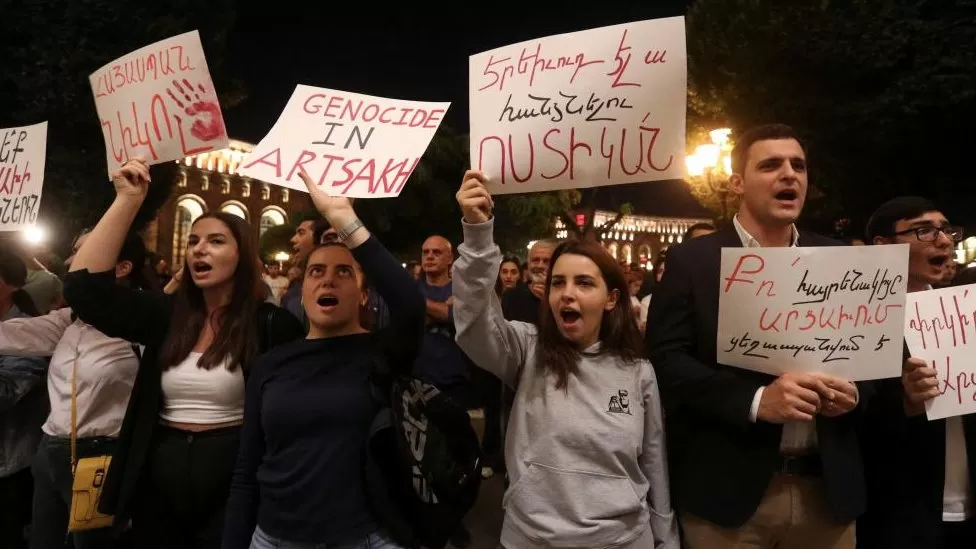
There were clashes between police and demonstrators in the Armenian capital of Yerevan on Wednesday, as thousands protested the government’s handling of the Nagorno-Karabakh crisis.

Azerbaijan said it had restored its sovereignty over the territory, after a deadly 24-hour military offensive.

It has led to Armenia being accused of failing to protect ethnic Armenians in the contested territory.

Protesters are calling for Armenia’s Prime Minister Nikol Pashinyan to quit.

They say he made too many concessions in the fight for Nagorno-Karabakh, and did little to help the ethnic Armenians who live there.

The territory is recognised internationally as part of Azerbaijan but large areas of it have been controlled by ethnic Armenians for three decades.

Pictures from Yerevan showed police in riot gear standing guard near a government building as some protesters threw rocks.

While some people peacefully waved flags and posters, others were shown injured and covered in blood.

“Our authorities have renounced Artsakh,” opposition politician Avetik Chalabyan told the crowd, using the Armenian name for Karabakh.

“The enemy is at our doorstep. We must change authorities to change national policy,” he added, while another lawmaker called for an impeachment procedure to be launched against the prime minister.

Another protester, Sargis Hayats, said Mr Pashinyan “must go” and told AFP news agency: “We are losing our homeland, our people.” Some 120,000 ethnic Armenians live in Nagorno-Karabakh.

On Tuesday, Azerbaijan’s military launched an “anti-terror” operation demanding that Karabakh’s forces surrender and disband their “illegal regime”.

Unable to get any support from Armenia because a key road has been blocked by Azerbaijan since December, the ethnic Armenians soon gave in.

On Wednesday, Azerbaijan’s president Ilham Aliyev insisted he had nothing against the ethnic Armenian population, only what he called their “criminal junta”.

In a televised address, he said Azerbaijan wished to integrate Karabakh’s population and turn the region into “paradise”.

But there are serious concerns at what could happen to the ethnic Armenians still in Nagorno-Karabakh.

Images posted on social media show thousands of Armenians gathered at the Russian-controlled airport in Khankendi – known as Stepanakert by ethnic Armenians – the capital of Karabakh trying to leave the territory.

A separatist official said on Wednesday that more than 10,000 people have been evacuated from Armenian communities to other settlements in the region “where relative safety can be provided”. Another official stated that at least 200 people were killed in the fighting, including civilians – although the BBC has not been able to verify these numbers.

Azerbaijan’s presidency said officials would meet Karabakh’s Armenian representatives for talks on “issues of re-integration” in the Azerbaijani town of Yevlakh on Thursday.