
Elections likely to be delayed as CCI ‘unanimously’ approves 2023 census

ISLAMABAD: The upcoming general elections in the country will likely be delayed as the Council of Common Interest (CCI) meeting on Saturday “unanimously” approved the 2023 census.

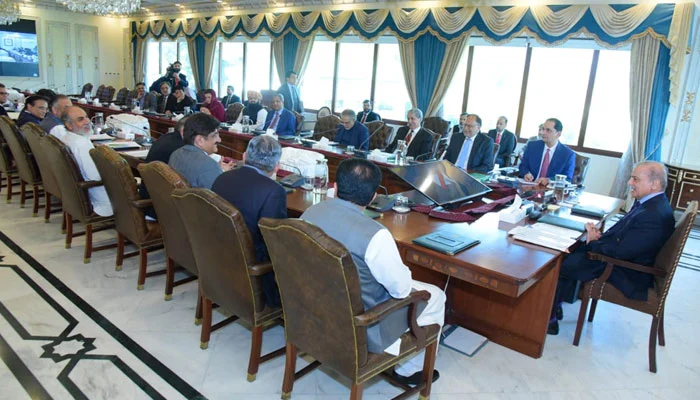
Prime Minister Shehbaz Sharif chaired a meeting of the CCI to decide the fate of the 2023 census amid reports of division among the coalition partners over the matter.

The meeting was attended by Sindh Chief Minister Murad Ali Shah and Punjab Caretaker Chief Minister Mohsin Naqvi.

Finance Minister Ishaq Dar, Planning Minister Ahsan Iqbal, Aviation Minister Khawaja Saad Rafique, Commerce Minister Syed Naveed Qamar, Adviser to the PM on Kashmir Affairs and Gilgit Baltistan Qamar Zaman Kaira and other officials also participated in the huddle.

According to a statement issued following the meeting, the census 2023 was approved with the consensus of all four chief ministers and representatives of all political parties.

During the meeting, PM Shehbaz appreciated the provincial governments and the Pakistan Bureau of Statistics (PBS) for playing an important role in completing the census.

The Ministry of Planning briefed the participants on the digital census. Moreover, the results of 2023 census were also presented during the CCI meeting.

The current total population of Pakistan is 241.49 million as per the seventh census with an annual growth rate of 2.55%.

The population growth rate of Balochistan is 3.2% — higher than the rest of the provinces.

“The population has increased by 350 million in the last six years which is a matter of concern. Pakistan’s population growth rate is more than its economic growth,” the PM said.

PM Shehbaz added that the government will have to stop the population growth as well as overcome the challenges by increasing the pace of economic development.

The population of Khyber Pakhtunkhwa is 40.85 million, Punjab 127.68 million, Sindh 55.69 million, Balochistan 14.89 million and Islamabad’s population stands at 2.36 million, the meeting was briefed.

The CCI huddle unanimously approved the latest digital census despite the Pakistan Peoples Party (PPP), a key ally of the Pakistan Democratic Movement (PDM)-led government, had publicly expressed reservations over it.

The Pakistan Bureau of Statistics (PBS) also reportedly informed the federal government that it had completed all the formalities.

The general elections are likely to be delayed by a couple of months as the Election Commission of Pakistan (ECP) would need additional time to conduct the delimitation exercise afresh.

Under the law, if a new census is notified, the ECP is bound to hold elections on the basis of new data.

It is important to note that the ruling coalition has agreed to dissolve the National Assembly prematurely on August 9 — three days before its term ends — giving the electoral body 90 days to conduct polls.

PPP, MQM-P divided

Meanwhile, the two main coalition partners of PM Shehbaz Sharif — Muttahida Qaumi Movement-Pakistan (MQM-P) and PPP had opposite views on the enumeration.

The PPP has on multiple occasions said that polls should be held on the basis of the 2017 census, reiterating that any delay in polls will not be accepted.

On Friday, while speaking on the floor of the Senate, Minister for Climate Change Sherry Rehman said that the census issue was controversial and would open up a new Pandora’s box of delimitation of constituencies.

“This issue could be used to delay the election. We don’t want elections to be delayed, rather it should be held on time and under the Constitution,” she maintained.

On the other hand, MQM-P has shared its concerns on the matter with the prime minister, stressing that elections on the previous enumeration would not be acceptable.

PML-N ‘ready’ to address concerns

Moreover, Pakistan Muslim League-Nawaz (PML-N) leader Talal Chaudhry told Geo News that there’s no harm in delaying polls as it is more important that the election results are acceptable to everyone.

‘Polls may be delayed by 4 months’

Talking to Geo News on Friday, former secretary ECP Kanwar Dilshad said that if the CCI approves the census 2023, elections will be held in 2024.

“If the gazette notification of the new digital census is issued on the recommendations of the CCI, then the ECP is legally bound under Article 51(5) of the Constitution to conduct fresh delimitation,” he said.
Toshakhana case: What was PTI chief doing when police came to arrest him?

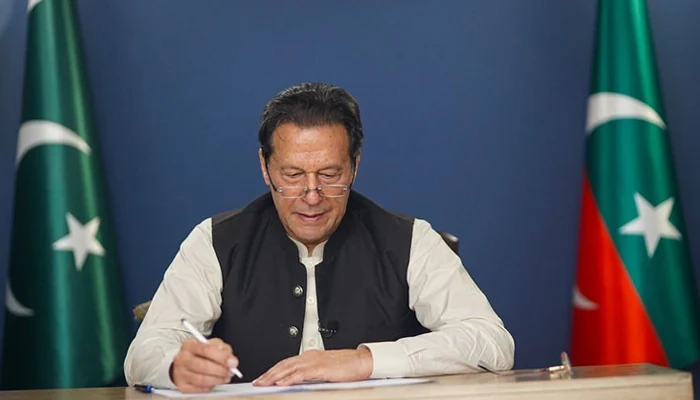
LAHORE: Shortly after a court in Islamabad found him guilty of corruption in the Toshakhana case Saturday, Pakistan Tehreek-e-Insaf (PTI) Chairman Imran Khan was arrested.

Additional district and sessions Judge (ADSJ) Humayun Dilawar ordered the police to arrest Khan — who wasn’t present at the hearing as he was at his Zaman Park residence in Lahore.

The Punjab Police entered the Lahore residence of Khan, who was removed as the prime minister via a no-confidence motion last year in April, through the back door.

When they approached Khan, he was wearing a blue tracksuit and was eating lunch.

Khan told the police that he needs to eat, but the law enforcers insisted that they had to arrest him on court orders and that he could eat later on.

The police then took the PTI chairman into their custody and stopped his guards within the home’s premises.

His arrest triggered protests in several cities of the nation, with the party vowing to challenge the lower court’s decision in the superior courts.

The former prime minister was sent to jail for three years Saturday after a court in the capital found him guilty of graft in the Toshakhana case, a move likely to bar him from standing in elections due later this year.

Anyone convicted of a criminal offence is disqualified from contesting elections in Pakistan, and parliament is likely to be dissolved in the next two weeks before it completes its term, with a national vote to be held by later this year or early next year.

“His dishonesty has been established beyond doubt,” Judge Dilawar wrote in the ruling seen for a case centred on gifts he received and did not properly declare while he was premier.

The judge also fined him Rs100,000 (around $350).

Death toll rises to 30 in northern China floods

Officials reported the deaths in Baoding, about 150 kilometres (90 miles) from Beijing, adding that 18 people were missing.

Storm Doksuri, a former super typhoon that hit mainland China last Friday, has brought the most severe rains to the region since records began 140 years ago.

By noon Saturday (0400 GMT), more than 600,000 of Baoding’s 11.5 million residents had been evacuated from areas deemed to be at risk, officials said.

The torrential rain that hit northeast China on Saturday battered the provinces bordering Russia and North Korea.

A red alert remains in force in Beijing due to “geological risks” such as landslides linked to the bad weather.

Clean-up operations are ongoing after the overwhelming rainfall, which destroyed infrastructure and flooded entire districts.

China has been hit hard by extreme weather in recent months, from record-breaking heatwaves to deadly flooding.

Natural disasters caused 147 deaths or disappearances last month, China said Friday, after the heaviest rains since records began hit the country’s capital.

China’s Ministry of Emergency Management said 142 of the deaths or disappearances recorded in July were caused by flooding or geological disasters.

Streets became rivers

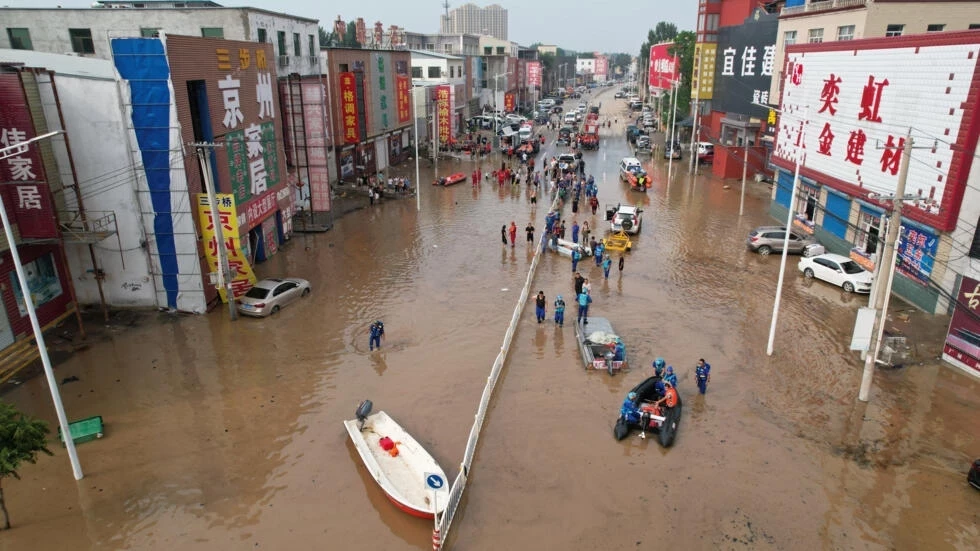
Dramatic aerial photographs taken by AFP of Zhuozhou on Wednesday showed shopping streets turned into rivers of brown water, while others showed farmland in the surrounding areas completely submerged and floodwater stretching for miles.

AFP saw rescuers using boats to ferry instant noodles, bread and drinking water to residents who could not or did not want to leave properties engulfed by water.

Millions of people have been hit by extreme weather events and prolonged heatwaves around the globe in recent weeks, events that scientists say are being exacerbated by climate change.

Ma Jun, director of the Beijing-based NGO the Institute of Public and Environmental Affairs, said that while the typhoon had brought the rain, rising ocean temperatures due to climate change were also causing the extreme weather.

“China has suffered unprecedented extreme heatwaves since last year… This year, there are record-breaking high temperatures in Northern China,” Ma told AFP this week.

“These heatwaves are linked to global warming, and this is what most climate scientists around the world tend to agree,” he said.

Saudi dives into Ukraine peace push with Jeddah talks

The meeting, which Ukrainian organisers had said would include representatives from around 40 countries but not Russia, began on Saturday in the Red Sea coastal city of Jeddah, participants said.

Agenda of the session features three hours of statements from various delegations before a two-hour closed discussion and a dinner.

“I predict that the conversation will not be easy, but the truth is on our side,” Andriy Yermak, the head of Ukraine’s presidential office, said in an interview broadcast earlier.

“We have many disagreements and we have heard many positions, but it is important that we share our principles,” added Yermak, who also heads Kyiv’s delegation to Jeddah.

“Our task is to unite the whole world around Ukraine.”

Russia invaded Ukraine on Feb 24 last year, failing in its attempt to take the capital but seizing swathes of eastern territory that Western-backed Ukrainian troops are fighting to recapture.

Ukrainian President Volodymyr Zelensky’s office said this week that the meeting would focus on his 10-point peace formula that calls for the full withdrawal of Russian troops and restoration of Ukraine’s borders, including the territory of Crimea, annexed by Russia since 2014.

However, Russia has in the past made it clear that any negotiations would need to take into account “new territorial realities”.

Bringing in BRICS

The Jeddah meeting follows talks in Copenhagen in June that were designed to be informal and did not yield an official statement.

US National Security Adviser Jake Sullivan is leading Washington’s delegation to the Saudi city, a senior White House official said.

While Washington does not expect a major breakthrough or joint statements to come out of Saturday’s session, diplomats instead said the Ukraine-organised meetings were intended to engage a range of countries in debates about a path towards peace — notably members of the BRICS bloc with Russia that have adopted a more neutral stance on the war in contrast to Western powers.

China, which says it is a neutral party in the conflict but has been criticised by Western countries for refusing to condemn Russia, announced it would send its special representative for Eurasian affairs, Li Hui, to the meeting.

The meeting highlights Saudi Arabia’s “readiness to exert its good offices to contribute to reaching a solution that will result in permanent peace”, the official Saudi Press Agency said.

The world’s biggest crude exporter which works closely with Russia on oil policy, Riyadh has touted its ties to both sides and positioned itself as a possible mediator in the war.

Takes two to tango, Pakistan tells India

“There should be some resonance of reciprocity from New Delhi as well,” said Pakistan’s US ambassador, and a former president of Azad Kashmir, while addressing a meeting in Washington. “It takes two to tango. It can’t be a monologue. It needs to be a dialogue.”

Addressing a summit in Islamabad earlier this week, Prime Minister Shehbaz Sharif had expressed his willingness to hold talks with India.

On Aug 3, the US also backed efforts to resume India-Pakistan talks. Asked to comment on Mr Sharif’s offer, US State Depart­ment spokesman Matthew Miller said: “As we have long said, we support direct dialogue between India and Pakis­tan on issues of concern.” India, however, has rejected Pakistan’s offer, saying that Islamabad needs to create an ‘environment’ for peace before the talks resume.

Ambassador Khan, however, reiterated the talks offer at a meeting called to mark Aug 5 as the “day of usurpation”.

A large number of Pakistani and Kashmiri Americans, members of civil society and human rights activists attended the event. Messages from President Arif Alvi and Prime Minister Sharif reiterated their unswerving commitment to the Kashmir cause.

Videos highlighting the struggle of Kashmiri people and Indian atrocities were also played. Pakistan released a set of documents, authored by human rights groups and media activists, showing the situation in the Indian-occupied territory.

Britain’s Shadow Minister for Legal Aid Afzal Khan said Labour MPs had urged the government not to abdicate its historical responsibility and to play its part in promoting sustainable peace and prosperity in the region. Human rights activist Shamim Shawal said that 9,000 girls were missing since 2019 and 181 children were missing since 2022.

‘Adapt and innovate’

Muzammil Ayub Thakur, president of the World Kashmir Freedom Movement, advised the people of Kashmir to “learn to adapt and innovate” to make sure that their struggle for freedom succeeds.

The Chancellor of East West University, Chicago, Wasiullah Khan, urged Kashmiris to continue their peaceful struggle for freedom.

Senator Abdul Qayyum said peace-loving nations must stand with all oppressed people of the world, including the Kashmiris.

Mohsin Ansari, the presi­dent of Islamic Circle of North America, offered continued support of his organisation to the people of Kashmir.

Professor Imtiaz Khan of George Washington University said the people of India should learn to look beyond the rhetoric of their government and see how it was suppressing the Kashmiri people.

Cambodia’s outgoing leader Hun Sen has marked his 71st birthday with official confirmation of his party’s landslide victory in last month’s election.

Electoral officials said on Saturday that his ruling Cambodian People’s Party (CPP) had swept 120 of 125 seats.

Critics called July’s poll a sham after the main opposition, the Candlelight Party, was banned on a technicality.

But the result allows Hun Sen to proceed with a plan to appoint his son as his successor in the coming days.

Hun Manet, 45, was until recently the commander of the Royal Cambodian Army and has long been groomed for the role. The transition was first flagged in 2021, but until July it was unclear when the change of power would occur.

Saturday’s confirmation that Hun Manet had been elected an MP removed the only remaining procedural hurdle to his taking office.

His father is now expected to ask the King to appoint him prime minster on Monday. Hun Sen has said the succession is designed to maintain peace and avoid “bloodshed” should he die in office.

He is expected to become president of the Senate early next year and will serve as acting head of state when King Norodom Sihamoni is abroad.

Since he came to power following the fall of the murderous Khmer Rouge regime four decades ago, Hun Sen’s rule has become increasingly authoritarian.

He has consolidated power through control of the military, police and moneyed interests. Observers say he has dispatched opponents through co-opting, jailing or exiling them.

Indeed, there was little doubt over the result of last months poll, with some critics branding it more like a coronation than an election.

The Candlelight Party, Cambodia’s main opposition and the sole credible challenger to Hun Sen, was disqualified from contesting the election in May after officials accused the party of filing incorrect paperwork.

Apart from the CPP, the royalist Funcinpec Party took five seats, while the remaining 16 opposition parties all failed to gain any representation.

The CPP took 6,398,311 votes from a total of 8.2 million ballots cast, or 78% of the popular vote. Before the poll, the government criminalised any attempt to boycott the election or spoil the ballot papers.

The US, EU and other Western nations refused to send observers to the poll, saying it was neither free not fair.

EU officials said the vote was “conducted in a restricted political and civic space where the opposition, civil society and the media were unable to function effectively without hindrance”.

Hun Manet celebrated Saturday’s result by posting a photo to Instagram showing his young son presenting Hun Sen with a bouquet of blue and yellow flowers, captioned with the message: “Happy birthday to respected and beloved father”.

Storm Antoni: Strong winds and heavy rain set to clear

Storm Antoni hit several parts of England, Wales and Northern Ireland between Friday and Saturday.

Some residents were evacuated due to flooding and events such as Brighton’s Pride were also hit.

Yellow rain warnings in Northern Ireland and amber wind warnings in Wales and southwest England ended on Saturday.

The yellow warnings for thunderstorms in south-east England, including Brighton and London, ended at 22:00 BST, along with the yellow wind warnings in western areas including Cardiff and Bath.

The Met Office said winds would continue to ease overnight into Sunday, with “a few showers” persisting near coasts.

Storm Antoni hit late on Friday, with gusts of up to 65mph affecting exposed coastal areas.

The Met Office issued warnings for affecting areas encompassing Plymouth, Bristol and Bath in England and Swansea, Carmarthenshire and Pembrokeshire in Wales.

It warned that danger to life from flying debris were possible and “large waves and beach material being thrown on to sea fronts, coastal roads and properties”.

On Saturday, Cleveland Police said residents in Loftus and Carlin How, North Yorkshire were evacuated due to flooding. The force warned people not drive to the homes of relatives or make unnecessary journeys.

Trees fell on the road to Veryan on the Roseland Peninsula in Cornwall on Saturday

Met Office chief meteorologist Steve Willington previously said the storm has the potential to bring “potentially disruptive” weather as it moved from west to east.

Mr Willington said Northern Ireland would see some of the highest rainfall totals, with 40-60mm falling in some spots.

Meanwhile, Brighton’s Pride still went ahead, despite the challenges from the weather and industrial action on the railways.

This person braved the wind and rain to head down to Brighton seafront

However, a Pride festival in Devon was scaled back due to concerns over strong winds.

Plymouth Pride 2023 said a “rainbow village” featuring up to 80 traders would be cancelled because of the potential for “flying gazebos”.

Storm worries have seen the annual Stompin’ on the Quomps festival cancelled for the first time in its 30-year history in Christchurch. Around 10,000 people had been expected to attend on Saturday.

Imran Khan arrested after he was found guilty in Toshakhana case

ISLAMABAD: Pakistan Tehreek-e-Insaf (PTI) Chairman Imran Khan was arrested from his Zaman Park residence in Lahore soon after being convicted in the Toshakhana case on Saturday.

In a major development, a district and sessions court today convicted the former prime minister in the Toshakhana case, sentencing him to three years in prison.

Rejecting Khan’s petition seeking inadmissibility of the case, Judge Dilawar sentenced the former prime minister to three-year imprisonment.

“Charges of misdeclaration of assets have been proven against PTI chairman,” the Additional and Sessions Judge Humayun Dilawar mentioned in his judgment.

He then handed Khan three years in jail along with a fine of Rs100,000, while issuing his arrest warrant.

The former prime minister had challenged the Toshakhana case, related to the alleged misdeclaration of gifts he took from the state gifts repository, on several forums including the Supreme Court and Islamabad High Court (IHC).

The trial court had summoned Khan in his personal capacity today (Saturday) for a hearing in the Toshakhana case after the high court rejected his pleas challenging the maintainability order.

On Friday, the IHC also turned down Khan’s request to transfer the case to another court and directed Additional Sessions Judge Humayun Dilawar to continue hearing the case.

China executes South Korean for drug trafficking

China has executed a South Korean national for drug trafficking, Beijing’s foreign ministry said, the first time such a sentence has been carried out on a citizen of that country in almost a decade.

A court in the southern Chinese city of Guangzhou “lawfully pronounced a verdict and executed the South Korean defendant… for drug trafficking” on Friday, the foreign ministry said in a statement.

“When defendants of different nationalities commit crimes on Chinese territory, Chinese law shall be applied equally”, it added.

An official from Seoul’s foreign ministry told reporters Friday that “the death penalty was carried out today for a South Korean citizen who was sentenced to death for selling drugs in China”.

Beijing said the individual, who Chinese officials named as Jiang — which would be rendered Kang in Korean — had had their “legitimate rights and interests” protected.

South Korea expressed “regret that the death penalty has been carried out against our citizen”.

“The government has made multiple requests for reconsideration or postponement of the execution on humanitarian grounds through various channels since the death sentence was announced,” the official said.

It is the first execution of a South Korean drug offender by China in nine years, South Korea’s Yonhap news agency reported.

The individual was arrested in China in 2014 in possession of five kilograms of methamphetamine, according to Yonhap.

He was sentenced to death in 2019, the agency said.

China, the world’s top executioner, frequently carries out the death penalty by lethal injection for very serious crimes.

The Chinese legal system is tightly controlled by the ruling Communist Party and courts have a near-100 percent conviction rate in criminal cases.

Like many countries in the region, China has strict drug laws, and several foreign nationals have been handed death penalties for trafficking in recent years.

In 2020, an Australian was sentenced to death in China for drug trafficking.

According to Chinese media, he was arrested at Guangzhou airport in December 2013 with more than 7.5 kilograms of methamphetamine in his luggage.

And in 2019, China sentenced two Canadian nationals accused of drug trafficking to death at a time when relations with Ottawa were nosediving.

Seoul said Friday’s execution was “unrelated to the relationship between China and South Korea”.

Saudi dives into Ukraine peace push with Jeddah talks

The meeting of national security advisers and other officials in the Red Sea coastal city of Jeddah underscores Riyadh’s “readiness to exert its good offices to contribute to reaching a solution that will result in permanent peace,” the official Saudi Press Agency said Friday.

Invitations were sent to around 30 countries, Russia not among them, according to diplomats familiar with the preparations.

The SPA report said only that “a number of countries” would attend.

It follows Ukraine-organised talks in Copenhagen in June that were designed to be informal and did not yield an official statement.

Instead, diplomats said the sessions were intended to engage a range of countries in debates about a path towards peace, notably members of the BRICS bloc with Russia that have adopted a more neutral stance on the war in contrast to Western powers.

Speaking on Friday, Ukrainian President Volodymyr Zelensky welcomed the wide range of countries represented in the Jeddah talks, including developing countries which have been hit hard by the surge in food prices triggered by the war.

“This is very important, because on issues such as food security, the fate of millions of people in Africa, Asia, and other parts of the world directly depends on how fast the world moves to implement the peace formula,” he said.

Saudi Arabia, the world’s biggest crude exporter which works closely with Russia on oil policy, has touted its ties to both sides and positioned itself as a possible mediator in the war, now nearly a year and a half old.

“In hosting the summit, Saudi Arabia wants to reinforce its bid to become a global middle power with the ability to mediate conflicts while asking us to forget some of its failed strategies and actions of the past, like its Yemen intervention or the murder of Jamal Khashoggi,” said Joost Hiltermann, Middle East programme director for the International Crisis Group.

The 2018 slaying of Khashoggi, a Saudi columnist for The Washington Post, by Saudi agents in Turkey once threatened to isolate Crown Prince Mohammed bin Salman, the kingdom’s de facto ruler.

But the energy crisis produced by the Ukraine war elevated Saudi Arabia’s global importance, helping to facilitate his rehabilitation.

Moving forward Riyadh “wants to be in the company of an India or a Brazil, because only as a club can these middle powers hope to have impact on the world stage,” Hiltermann added.

“Whether they will be able to agree on all things, such as the Ukraine war, is a big question.”

‘Balancing’

Russia invaded Ukraine on February 24, 2022, failing in its attempt to take Kyiv but seizing swathes of territory that Western-backed Ukrainian troops are fighting to recapture.

Beijing, which says it is a neutral party in the conflict but has been criticised by Western capitals for refusing to condemn Moscow, announced on Friday it would participate in the Jeddah talks.

“China is willing to work with the international community to continue to play a constructive role in promoting a political settlement of the Ukraine crisis,” said foreign ministry spokesperson Wang Wenbin.

India has also confirmed its attendance in Jeddah, describing the move as in line “with our longstanding position” that “dialogue and diplomacy is the way forward”. South Africa said it too will take part.

Saudi Arabia has backed UN Security Council resolutions denouncing Russia’s invasion as well as its unilateral annexation of territory in eastern Ukraine.

Yet last year, Washington criticised oil production cuts approved in October, saying they amounted to “aligning with Russia” in the war.

This May, the kingdom hosted Zelensky at an Arab summit in Jeddah, where he accused some Arab leaders of turning “a blind eye” to the horrors of Russia’s invasion.

In sum, Riyadh has adopted a “classic balancing strategy” that could soften Russia’s response to this weekend’s summit, said Umar Karim, an expert on Saudi politics at the University of Birmingham.

“They’re working with the Russians on several files, so I guess Russia will deem such an initiative if not totally favourable then not unacceptable as well.”