
PM Shehbaz, Zardari discuss caretaker set-up, general elections

Just days before the end of their five-year term, top leadership of Pakistan Peoples Party (PPP) and Pakistan Muslim League Nawaz — two main coalition partners in the federal government — on Saturday joined heads to mull over their political strategy, upcoming general elections on the interim set-up

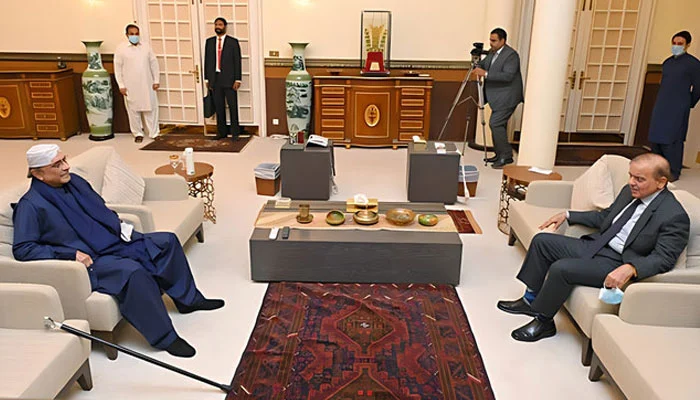
PPP co-chairman Asif Ali Zardari held a one-on-one meeting with Prime Minister Shehbaz Sharif at his Model Town residence today, in which matters pertaining to country’s overall political situation, caretaker set-up and other issues were discussed.

During the meeting that lasted for one hour, the former president proposed to the premier to dissolve the assemblies in the second week of August. PM Shehbaz assured that he would take all the coalition partners into confidence on his proposal.

It is pertinent to mention here that the incumbent National Assembly will complete its constitutional term on August 12. The premier, however claimed that his government will complete its term on August 14.

Both the leaders agreed to hold the next general elections on time, the sources said, adding that they vowed “not to tolerate any delay in the elections.”

It is also discussed in the meeting that a politician should be appointed as a caretaker PM instead of a retired bureaucrat for this time.

The PPP co-chairman also commended the premier over the International Monetary Fund (IMF) deal.

The IMF deposited $1.2 billion into the State Bank of Pakistan’s (SBP) account yesterday, boosting the cash-strapped nation’s hope for economic stability, as it teetered on the brink of default for several months.

The global lender’s executive board approved a $3 billion Stand-By Agreement (SBA) under a nine-month programme. Pakistan reached a staff-level agreement with the lender last month, securing a short-term pact, which got more than expected funding for the crises-hit country of 230 million.

PM Shehbaz on interim set-up

On July 13, PM Shehbaz had said that the coalition government will hand over the reins of the regime to the interim set-up in August ahead of the general elections in the country which are expected to take place in October or November.

“In August 2023, we will give responsibility to the interim government,” the premier said in an address to the nation.

The premier repeated the circumstances in which the coalition government — a group of 13 political parties — came to power in April 2022.

“[We] cleaned up the mess of four years in 15 months and doused the fire that had engulfed the economic and foreign relations front,” he said, adding that during their 15 months in power, the coalition government “saved the state, not politics”.


PM Shehbaz calls for immediate reforms to steer Pakistan out of crises

Prime Minister Shehbaz Sharif has emphasised the need for immediate structural reforms to steer the country out of crises saying that there is no other way but to take initiate “drastic structural and economic reforms”.

Addressing the office-bearers of the Lahore Chamber of Commerce and Industry (LCCI) and renowned businessmen and industrialists at Governor’s House in Lahore, the premier said sacrifices of all stakeholders including the business community required to deal with prevailing challenges.

PM Shehbaz said the government was taking all possible measures for the promotion of industry and agriculture. However, in the given circumstances and in the face of grave challenges, industrialists and the business community would have to play their role even more actively for enhancing exports and stabilising the economy, he added.

Citing an example of Bangladesh textile industry, PM Shehbaz urged the business community to examine as to why Pakistan’s economy was unable to achieve the desired targets and its full potential despite having all natural resources.

Bangladesh textile sector totally relies on imported cotton, but it is developing fast and gaining a niche in the global market while Pakistan’s textile is losing competition in the export markets, the PM added.

Pakistan’s foreign reserves jump to $14 billion

In the same address, the PM disclosed that the country’s total foreign exchange reserves rose to $14 billion after the country received funds from friendly countries and International Monetary Fund (IMF) following a $3 billion Stand-By Arrangement (SBA).

He said that the incumbent government saved the country from default as the country received $2 billion from Saudi Arabia, $1 billion from UAE and $1.2 billion from the IMF.

PM Shehbaz said forex reserves stood at $14 billion when the coalition government came to power in April last year, adding that the reserves reached the same level where they were previously.

He also lauded China’s financial support to Pakistan saying that Beijing rolled over $5 billion of commercial and sovereign loans, which played a key in securing the IMF bailout package.

“We have to take optimum benefit from the IMF deal by utilising the amount on economic development and people’s prosperity,” he remarked.

He added that unfortunately, the Pakistan-US relations were hit hard by the “ill-conceived decisions and remarks” by the previous Pakistan Tehreek-e-Insaf (PTI)-led government.

The incumbent coalition government with collective efforts normalised and improved ties with the USA, he added.

During the previous government, the PM said, national interests were compromised for personal interests, and the economic situation became even worse when the IMF pact was violated in the past.

Paris bans protest against police violence

Authorities have attempted to clamp down on demonstrations to avoid further chaos after the week of riots saw massive destruction to public and private property.

Interior Minister Gerald Darmanin had announced the ban on Wednesday of any protest “directly linked to the riots” that followed the shooting of 17-year-old Nahel during a traffic stop.

A video of a police officer shooting the teen at point-blank range went viral, fuelling old tensions over police brutality and racism in the country. An administrative court in Paris upheld the ban on Saturday, after a last-ditch effort by protest organisers to appeal the decision.

“Given the very recent nature of the serious riots”, a lack of police availability, and the risk of disturbances, the judges ruled that banning the protest was the only option.

Lucie Simon, a lawyer for the protest organisers — made up of a grouping against police violence and other associations — accused authorities of “impeding all channels of democratic expression of perfectly legitimate demands.”

Last Saturday, some 2,000 people defied a similar ban to join a memorial rally in central Paris for a young black man who died in police custody in 2016, while protests against police brutality took place around France.

India ties up with UAE to settle trade in rupees

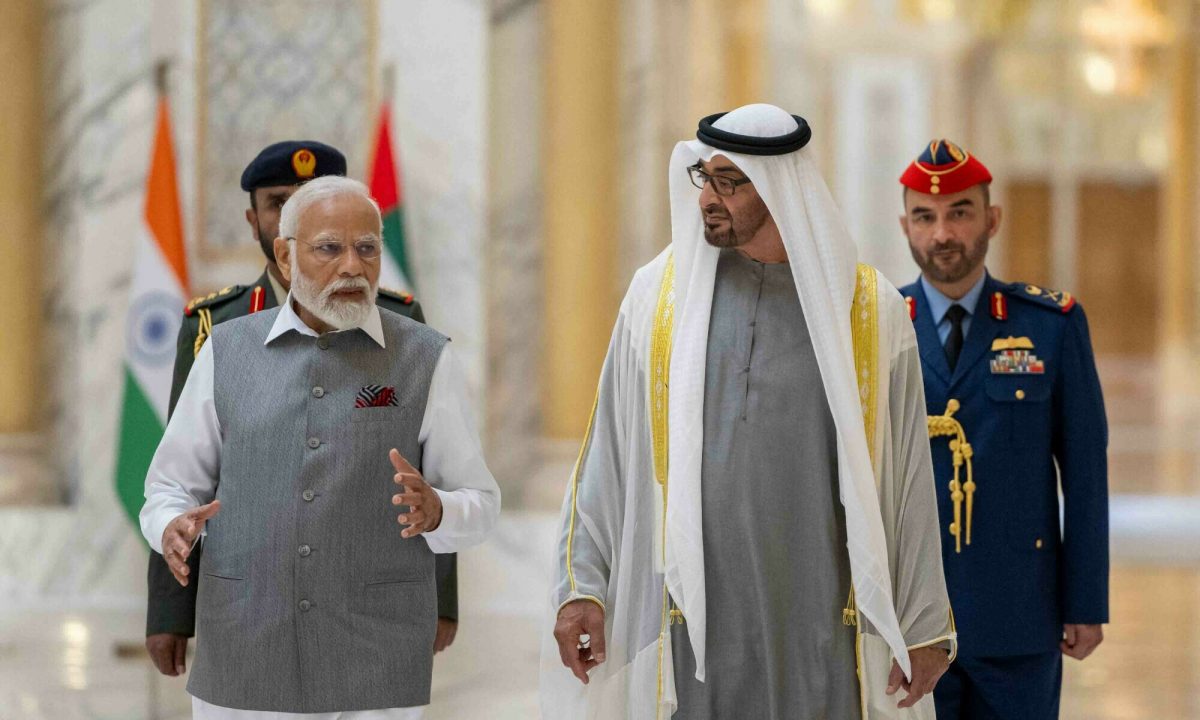
During a visit by India’s Prime Minister Narendra Modi to the UAE on Saturday, the two countries also agreed to set up a real-time payment link to facilitate easier cross-border money transfers.

The two agreements will enable “seamless cross-border transactions and payments, and foster greater economic cooperation”, said a statement from the Reserve Bank of India on Saturday.


India, the world’s third biggest oil importer and consumer and whose central bank last year announced a framework for settling global trade in rupees, currently pays for UAE oil in dollars.

Bilateral trade between the two countries was $84.5 billion in the year from April 2022 to March 2023.

An official with knowledge of the details of the agreement said India could make its first rupee payment for UAE oil to Abu Dhabi National Oil Co (ADNOC), Reuters reported on Friday.

The Reserve Bank of India said the two central banks agreed to link India’s Unified Payments Interface (UPI) and UAE’s Instant Payment Platform (IPP).

Such arrangements, which are a growing trend in Asia, typically lower the cost of payments.

Modi landed in Abu Dhabi earlier on Saturday for a one-day visit and met President Sheikh Mohamed bin Zayed Al Nahyan.


China calls on India to meet ‘halfway’ on border issue

Relations between India and China have deteriorated in recent months over their contested Himalayan border, and a visa spat in which the two sides have expelled nearly all of each other’s journalists.

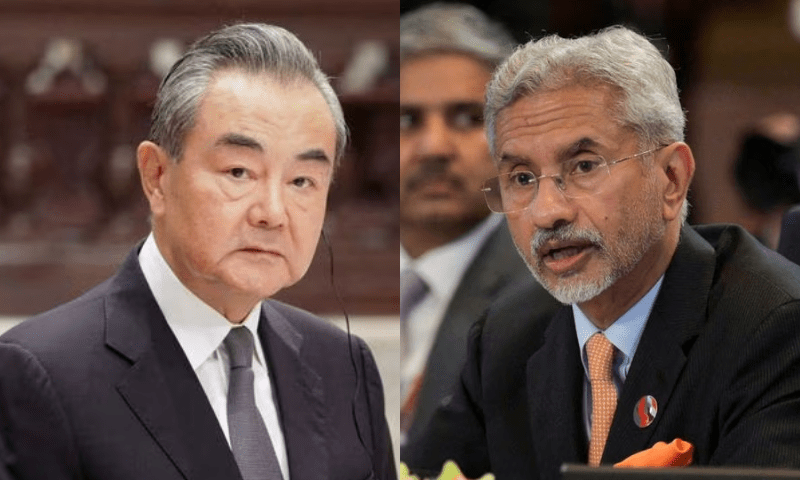
“China and India’s common interests clearly outweigh their differences,” Wang Yi told Indian Foreign Minister Subrahmanyam Jaishankar, when the two met on Friday on the sidelines of Southeast Asian talks in Jakarta, the Chinese foreign ministry said in a statement.


“The two sides should support each other, rather than… suspect each other,” Mr Wang added.

Commander-level talks on the issue expected ‘as soon as possible’

India and its northern neighbour are locked in a military standoff along their mostly undemarcated border in the Ladakh region.

Beijing also claims the Indian state of Arunachal Pradesh as part of Tibet, and it considers Kashmir a disputed territory. “It is hoped that the Indian side will meet China halfway and find a solution to the border issue that is acceptable to both sides,” Mr Wang said.

The two countries have agreed to hold the next round of military commander-level talks on the border issue “as soon as possible”, the ministry statement said.

Despite frosty relations, China is India’s second-largest trade partner.

In 2020, India sought to limit investments from China as political tensions heightened between them, with their soldiers clashing in the disputed Himalayan region.

“China is highly concerned about India’s recent restrictive measures against Chinese companies,” Mr Wang added, while urging New Delhi to provide a “fair, transparent and non-discriminatory business environment”.

Heavy rains, flooding leave 33 dead in South Korea

South Korea is at the peak of its summer monsoon season, and there has been heavy rainfall for the last four days, causing a major dam to overflow.

The interior ministry reported that 33 people had been killed and another 10 were missing in the heavy downpours, mostly buried by landslides or after falling into a flooded reservoir.

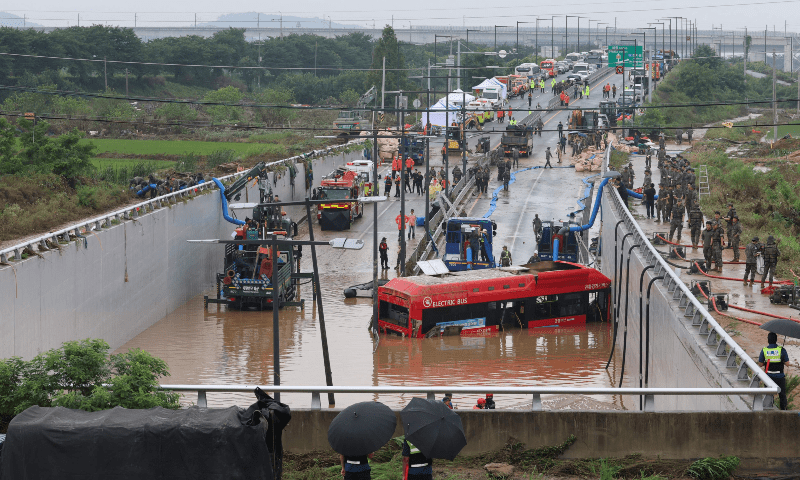
Rescue workers were still struggling to reach more than 10 cars trapped in a 430-metre underground tunnel in Cheongju, North Chungcheong province, the ministry said.


The tunnel was inundated on Saturday morning after floodwaters swept in too quickly for the people inside to escape, according to the Yonhap news agency.

As of Sunday, seven bodies have been recovered from the tunnel and divers were working around the clock searching for more victims, the interior ministry said.

“I have no hope but I can’t leave,” a parent of one of those missing in the tunnel told Yonhap.

“My heart wrenches thinking how painful it must have been for my son in the cold water.”

Images broadcast on local television showed a torrential stream of water from a nearby river that had burst its banks flooding into the tunnel, as rescue workers struggled to use boats to get to people inside.

South Korean President Yoon Suk Yeol, who is currently on an overseas trip, held an emergency meeting with his aides on the government’s response to the heavy rains and flooding, his office said.

Earlier, he ordered Prime Minister Han Duck-soo to mobilise all available resources to minimise casualties.

The majority of the casualties — including 17 of the dead and nine of the missing — were from North Gyeongsang province, and were largely due to massive landslides in the mountainous area that engulfed houses with people inside.

Some of the people who have been reported missing were swept away when a river overflowed in the province, the interior ministry said.

More rain is forecast through Wednesday, and the Korea Meteorological Administration has warned the weather conditions pose a “grave” danger.

South Korea is regularly hit by flooding during the summer monsoon period, but the country is typically well-prepared and the death toll is usually relatively low.

Scientists say climate change has made weather events around the world more extreme and more frequent.

South Korea endured record-breaking rains and flooding last year, which left more than 11 people dead.


They included three people who died trapped in a Seoul basement apartment of the kind that became internationally known because of the Oscar-winning Korean film “Parasite”.

The government said at the time that the 2022 flooding was the heaviest rainfall since Seoul weather records began 115 years ago, blaming climate change for the extreme weather.

UK Defence Minister Ben Wallace reveals resignation plans

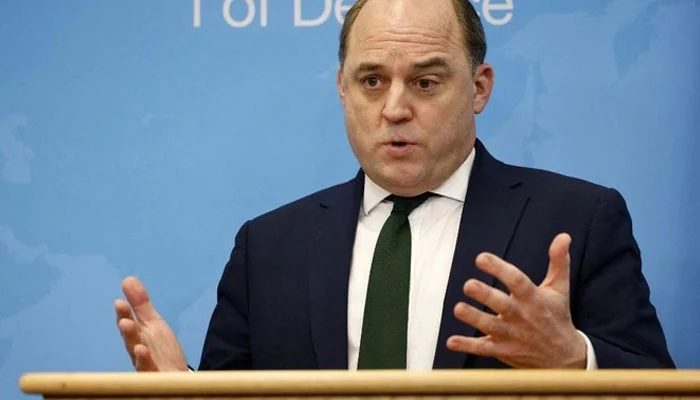
UK Defence Minister Ben Wallace has announced that he will be stepping down from his position as a lawmaker in the next election.

Wallace, who has been a prominent figure in supporting Ukraine against Russia, revealed his decision in an interview with the Sunday Times published on Saturday.

Wallace, who has served as the UK’s Defence Secretary for four years, played a crucial role in leading Britain’s response to Russia’s invasion of Ukraine. He had been considered a potential successor to Jens Stoltenberg as NATO secretary general, but failed to secure the necessary support from the United States. Consequently, Stoltenberg extended his term as head of the alliance.

In the interview, Wallace said, “I’m not standing next time,” confirming his intention not to seek re-election as a Member of Parliament. He further clarified that he would resign as defence secretary before the next cabinet reshuffle, which is expected to take place before September. Wallace also dismissed the possibility of triggering a by-election by quitting prematurely, emphasising his commitment to serving his full term.

Expressing his concerns about potential conflicts, Wallace highlighted the danger of military confrontation with Russia, saying, “If Putin loses in Ukraine, he will be deeply wounded… There is an ability for him, in the next three or four years, to lash out.”

Citing concerns over the increasing global instability and the potential for future conflicts, he also expressed apprehension about the global security situation, suggesting that the world would become more unsafe and insecure by the end of the decade, possibly leading to a cold or warm conflict.

Wallace’s decision to step down as a lawmaker comes in the context of an upcoming general election in Britain within the next 18 months. The move is not based on the fear of his party losing, but rather due to the impending boundary changes that will eliminate his current parliamentary constituency. Despite being the longest-serving Conservative defence secretary since Winston Churchill, Wallace has never actively pursued the position of party leader.

As the UK faces an uncertain future, the departure of Ben Wallace raises questions about the nation’s defence strategy and its ability to navigate global challenges in the coming years. With his strong support among grassroots Conservatives, Wallace’s decision will undoubtedly impact the political landscape and government dynamics moving forward.

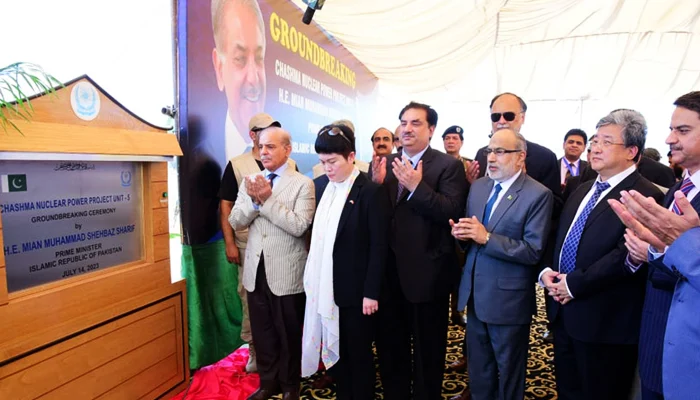
PM breaks ground on $3.48bn Chashma Nuclear Power Plant Unit-5

Prime Minister Shehbaz Sharif Friday broke ground on the 1,200 MW Chashma Nuclear Power Plant Unit 5 (C-5) in Mianwali, which is likely to be completed in seven to eight years at a cost of around $3.48 billion.

On June 30, 2023, the prime minister witnessed the signing of the Memorandum of Understanding (MoU) on the C-5 project between China National Nuclear Corporation Overseas Ltd (CNOS) and the Pakistan Atomic Energy Commission (PAEC).

Addressing the ground-breaking ceremony at Chashma, the prime minister said the project should be completed before the given schedule keeping in mind the country’s requirements for clean and cheap energy sources.

Terming it a huge milestone and a symbol of cooperation between the two great friends — China and Pakistan — Shehbaz said the project would help the country promote clean, efficient and comparatively cheaper energy.

He said after a pause of many years, the China-Pakistan Economic Corridor (CPEC) was going again in full swing. He gave the credit of concluding the agreement of C-5 to the coalition government and the SPD for their hard efforts.

“Our detractors had been fabricating rumours all around that Pakistan was going to default on its sovereign commitments but we crossed all turbulent waters in just 15 months,” he added.

However, he said the risk of potential default had been completely averted through the team effort of the government.

The prime minister said a couple of days ago, there was an approval of the International Monetary Fund (IMF) programme, and within 48 hours, around $4.5 billion were transferred by Pakistan’s brotherly countries Saudi Arabia and UAE, besides another $1.2 billion from the IMF.

About four months ago, he said the Chinese government and commercial banks rolled over amounts back to Pakistan to the tune of $5 billion.

He paid his tributes to Chinese President XI Jinping, Saudi Crown Prince Mohammad bin Salman, and UAE President Mohamed bin Zayed Al Nahyan for their support in the hour of need.

He informed that due to serious efforts by the coalition government and himself, the Chinese company kept the project cost at the level agreed upon in 2017-18 by the then-PML-N government and did not include the average inflation of around 10% in the project cost.

Further, he said on his request that a discount of Rs30 billion was also given to Pakistan, reflecting a sense of sincerity between the two countries.

Charge D’affaires of the Chinese embassy in Pakistan, Pang Chunxue, said C5 would help Pakistan build low-carbon, clean, and cheap energy, which would also produce local jobs and engage the local industries to contribute to the project.

Chairman of China National Nuclear Cooperation Yu Jianfeng said cooperation between Pakistan and China in nuclear energy had become an integral part of the all-weather strategic cooperative partnership.

He said the C5 project was a significant milestone in the HPR 1,000 development global journey. Hualong One (HPR 1000) is the 3rd-generation nuclear power brand to which China has exclusive intellectual property rights.

Planning Minister Ahsan Iqbal, Energy Minister Khurram Dastgir Khan, and Chairman PAEC Dr Raja Ali Raza were also present on the occasion.

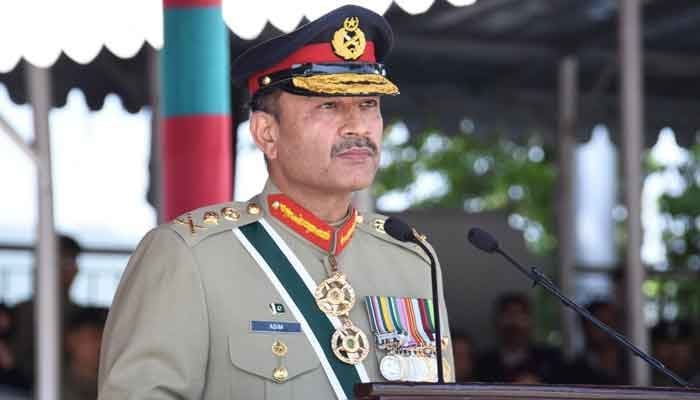
On Iran’s maiden visit as COAS, Gen Asim Munir to discuss defence ties

As his maiden visit to Iran as Chief of Army Staff (COAS), General Asim Munir has arrived in the neighbouring country on a two-day official visit, the military said on Friday.

According to the Inter-Services Public Relations (ISPR), the army chief will meet Iranian military and civilian leadership during his maiden visit since becoming the army chief in November last year.

During the visit, the COAS will discuss bilateral matters related to defence and security cooperation, the military’s media wing added.

This is Gen Munir’s fifth overseas trip ever since he took command of the Pakistan Army. In April, he paid an official visit to China for “enhancing bilateral military relations”.

During the visit, the army chief met China’s State Councilor Wang Yi and the commander of the Peoples Liberation Army (PLA) at the PLA Headquarters.

“The two sides reaffirmed China-Pakistan all-weather strategic partnership and underlined the importance of their strong defence cooperation for peace and stability in the region,” Pakistan’s envoy had tweeted following Gen Munir’s meeting with Wang Yi.

Earlier, the COAS also undertook visits to Saudi Arabia, the United Arab Emirates (UAE) and the United Kingdom.

During his time in Saudi Arabia in January this year, the COAS met Saudi Crown Prince Mohammad bin Salman and “reviewed bilateral relations and the ways of enhancing them”.

Later, Gen Munir visited the UAE and met President Sheikh Mohamed bin Zayed Al Nahyan and discussed defence and military ties.

The two also shared ways to strengthen military affairs to serve the common interests of the friendly countries during the meeting, as per the state news agency.

In February this year, Gen Munir visited the UK on a highly important visit on Britain’s Ministry of Defence invitation to discuss security-related strategic issues

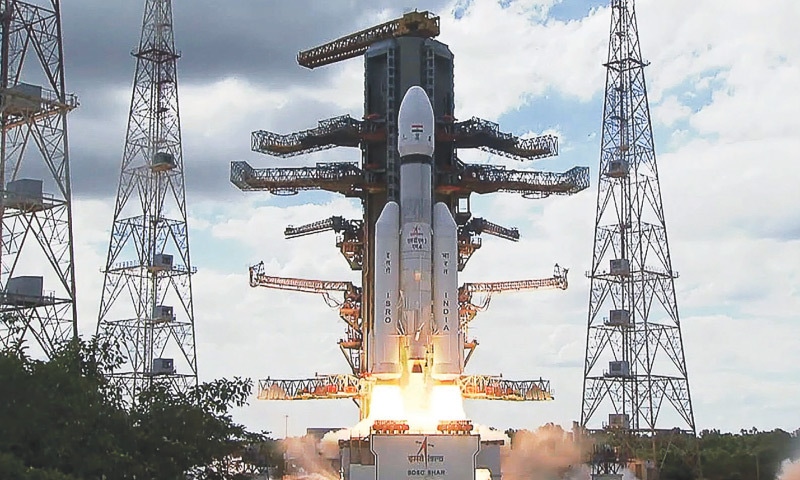
India launches cut-price moon mission in second attempt

The heavyweight LVM3-M4 rocket lifted off from Sriharikota in the southern state of Andhra Pradesh carrying the Chand­rayaan-3 spacecraft, as thousands of enthusiasts clapped and cheered.

“Chandrayaan-3… has begun its journey to the Moon. Health of the spacecraft is normal,” the Indian Space Research Organisation (ISRO) said on Twitter.

The world’s most populous nation has a comparatively low-budget aerospace programme that is rapidly closing in on the milestones set by global space powers.

Only Russia, the United States and China have previously achieved a controlled landing on the lunar surface.

Chandrayaan-3 scripts new chapter in country’s space odyssey, tweets PM

India’s last attempt to do so ended in failure four years ago, when ground control lost contact moments before landing.

“Chandrayaan-3 scripts a new chapter in India’s space odyssey,” Prime Minister Narendra Modi tweeted from France, where he was the guest of honour at the Bastille Day parade in Paris. “It soars high, elevating the dreams and ambitions of every Indian.”


If the rest of the current mission goes to plan, the Chandrayaan-3, which means “Mooncraft” in San­skrit, will safely touch down near the moon’s little-explored south pole between August 23 and 24.

Developed by ISRO, Chandrayaan-3 includes a lander module named Vikram, which means “valour” in Sanskrit, and a rover named Pragyan, the Sanskrit word for wisdom.

The mission comes with a price tag of $74.6 million — far smaller than those of other countries’, and a testament to India’s frugal space engineering.

Experts say India can keep costs low by copying and adapting existing space technology, and thanks to an abundance of highly skilled engineers who earn a fraction of their foreign counterparts’ wages.

‘A moment of glory’

The Chandrayaan-3 spacecraft will take much longer to reach the Moon than the manned Apollo missions of the 1960s and 1970s, which arrived in a matter of days.

The Indian rocket used is much less powerful than the United States’ Saturn V and instead the probe will orbit the earth five or six times elliptically to gain speed, before being sent on a month-long lunar trajectory.

If the landing is successful the rover will roll off Vikram and explore the nearby lunar area, gathering images to be sent back to Earth for analysis.

The rover has a mission life of one lunar day or 14 Earth days.

“It is indeed a moment of glory for India. Thank you team ISRO for making India proud,” Jitendra Singh, the junior minister for science and technology, told reporters after the launch.

ISRO chief S. Somanath has said his engineers carefully studied data from the last failed mission and tried their best to fix the glitches.

India’s space programme has grown considerably in size and momentum since it first sent a probe to orbit the moon in 2008.

In 2014, it became the first Asian nation to put a satellite into orbit around Mars, and three years later, the ISRO launched 104 satellites in a single mission.

The ISRO’s Gaganyaan (“Skycraft”) programme is slated to launch a three-day manned mission into Earth’s orbit by next year.

India is also working to boost its two percent share of the global commercial space market by sending private payloads into orbit for a fraction of the cost of competitors.