LHC to take up Imran Khan’s plea for immunity against arrest in new cases

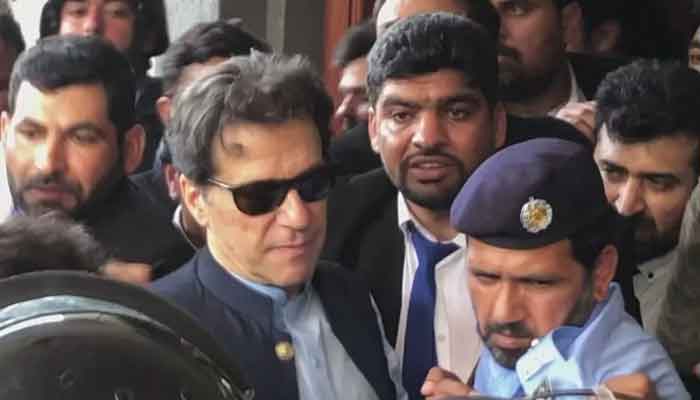
LAHORE: The Lahore High Court (LHC) is set to take up the plea filed by Pakistan Tehreek-e-Insaf (PTI) Chairman Imran Khan against the cases registered against him on May 9 — the day he was arrested in notorious Al-Qadir Trust case — and onwards.

The former prime minister — who had been incarcerated for three days in the land corruption case — had filed the plea on Saturday, a day after being released on bail from Islamabad High Court, fearing re-arrest in the new cases.

In the plea, Khan has sought the details of the cases registered against him in the light of countrywide protests that broke out following his arrest, as well as immunity against being detained.

“I am being politically victimised. There is a risk of arrest as police have nominated me in several cases,” the plea stated.

The PTI chief has made the Punjab inspector general and advocate general respondents in the case.

Khan’s dramatic arrest came last week when he was getting his biometrics done at the Islamabad High Court (IHC). Heavy Rangers force took the former cricket star into custody, acting on National Accountability Bureau (NAB) orders, and whisked him away in a black Rivo.

Violence ensued after the event which proved to be a major turn in the country’s restive politics as thousands of supporters and PTI workers took to streets for protests.

The countrywide demonstrations involved workers’ clashes with police, vandalism and attack on state property and vital installations including General Headquarters and Lahore Corps Commander House.

The dramatic saga also escalated tensions between Khan and the incumbent government as several cases were registered against the PTI chief and other party leaders for alleged involvement in inciting the riots.

In call with COAS Munir, UAE president reiterates commitment to Pakistan’s ‘stability’

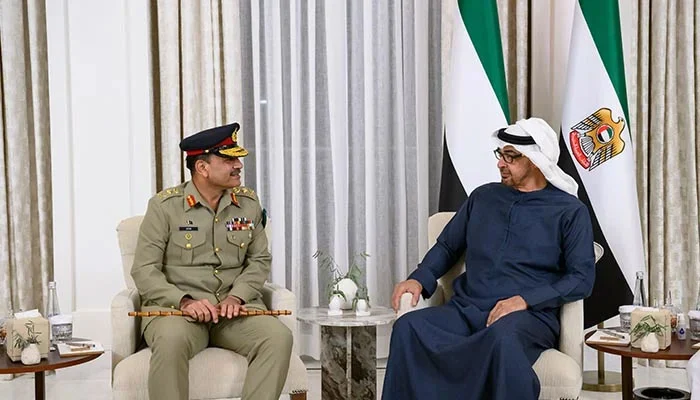
UAE President Sheikh Mohamed bin Zayed Al Nahyan on Sunday assured Chief of Army Staff (COAS) General Asim Munir of his country’s “commitment to supporting all that achieves unity and stability” in Pakistan

The UAE leader gave the assurance to the army chief during a telephone conversation.

As per the UAE news outlet, Sheikh Mohamed bin Zayed and Gen Aim Munir discussed the “enhancement of cooperation and joint work” between Abu Dhabi and Islamabad in “defence and military affairs, and ways to support and strengthen them to serve the mutual interests of both nations”.

In return, the army chief thanked and appreciated Sheikh Mohamed bin Zayed and “extended his wishes for the UAE’s continuous development, progress, and prosperity”.

The development comes as Pakistan passes through political and economic crises due to an ongoing tussle between the government and the rival Pakistan Tehreek-e-Insaf that has intensified after the arrest of former prime minister Imran Khan.

The Pakistani military has not issued yet any statement on the telephonic discussion between the two leaders.

UAE was among the first few countries that Gen Munir visited after taking charge as the chief of army staff. He had visited Saudi Arabia first and then stopped over in UAE earlier this year.

Pakistan is also seeking the UAE’s support to unlock the crucial International Monetary Fund (IMF) tranche to revive the Extended Fund Facility programme.

UAE, Saudi Arabia and China came to Pakistan’s assistance in March and April with pledges that would cover some of the funding deficit.

Thailand’s army-backed govt heads for drubbing in elections

But in a kingdom where coups and court orders have often trumped the ballot box, fears persist the military could seek to cling on, raising the prospect of fresh instability.

The election campaign played out as a clash between a young generation yearning for change and the conservative, royalist establishment embodied by Prime Minister Prayut Chan-O-Cha, the ex-army chief who seized power in a 2014 coup.

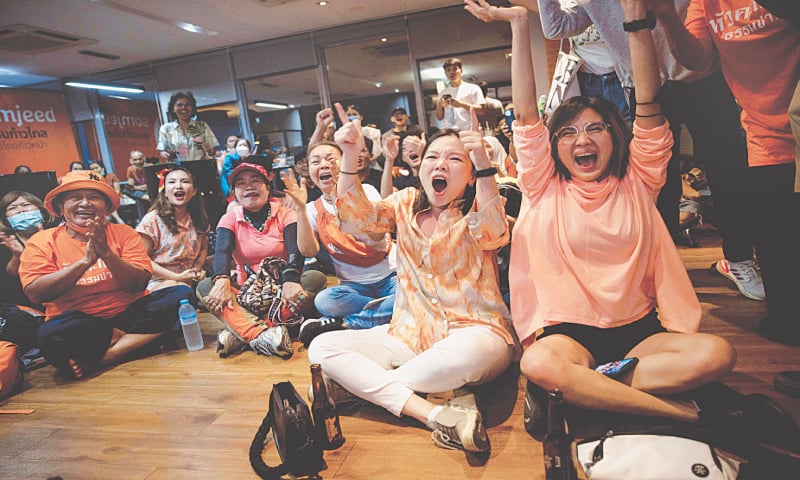
With ballots counted from three quarters of polling stations, the reformist Move Forward Party (MFP) was on nearly 8.4 million votes followed by Pheu Thai on 6.9m.

Prayut’s United Thai Nation party lay third on 2.8m, though it is not yet clear how the popular vote will translate into parliamentary seats.

MFP leader Pita Limjaroenrat said his party could take 160 of the 500 lower house seats, declaring that the result “closed the door” on any chance of army-backed parties forming a minority government.

MFP will seek talks with Pheu Thai and a coalition deal is “definitely on the cards”, Pita told reporters.

Pheu Thai leader Paetongtarn Shinawatra congratulated MFP on their success and said “we can work together”.

“We are ready to talk to Move Forward, but we are waiting for the official result,” she said.

Pheu Thai, the party of billionaire former premier Thaksin Shinawatra now fronted by his daughter, Paetongtarn, had urged voters to deliver them a landslide to see off the threat of military interference.

The Election Commission is not expected to officially confirm the final number of seats won by each party for several weeks.

But without an overwhelming majority, MFP and Pheu Thai may still face a battle to secure power, thanks to the junta-scripted 2017 constitution.

The new premier will be chosen jointly by the 500 elected MPs and 250 senate members appointed by Prayut’s junta — stacking the deck in the army’s favour.

In the controversial last election in 2019, Prayut rode senate support to become prime minister at the head of a complex multi-party coalition.

Adding to the uncertainty, rumours are already swirling that MFP could be dissolved by court order — the same fate that befell its predecessor Future Forward Party after it performed unexpectedly well at the 2019 poll.

Protest legacy

The election was the first since major youth-led pro-democracy protests erupted across Bangkok in 2020 with demands to curb the power and spending of Thailand’s king — breaching a long-held taboo on questioning the monarchy.

The demonstrations petered out as Covid-19 curbs were imposed and dozens of leaders were arrested, but their energy fuelled growing support for the more radical opposition MFP.

As he arrived to vote in Bangkok, Pita, 42, said he expected a “historic turnout”.

“Younger generations these days care about their rights and they will come out to vote,” he told reporters.

While MFP sought support from millennial and Gen Z voters — who make up nearly half the 52 million-strong electorate — Pheu Thai drew on its traditional base in the rural northeast where voters are still grateful for the welfare policies implemented by Thaksin in the early 2000s.

As results came in, a glum-looking Prayut thanked voters for their support as he left his party HQ.

“I’ll continue to do my best regardless of the result,” he told reporters.

The former general made an unashamedly nationalist pitch to older voters, painting himself as the only candidate capable of saving Thailand from chaos and ruin.

But he struggled badly in the polls, blamed for a sputtering economy and feeble recovery from the pandemic, which battered the kingdom’s crucial tourism industry.


A powerful cyclone has hit the coastlines of Bangladesh and Myanmar after intensifying into the equivalent of a category-five storm.

Cyclone Mocha did not make landfall at the world’s largest refugee camp in Cox’s Bazar, as earlier feared, but still destroyed hundreds of makeshift shelters in the camp.

At least five people have been reported dead in Myanmar.

No casualties have been reported in Bangladesh so far.

By late Sunday, the storm had largely passed. Bangladesh’s disaster official Kamrul Hasan said the cyclone caused “no major damage” in his country, but landslides and floods are still hitting the area.

Myanmar appears to have borne more direct impact, with the storm crashing through houses and cutting power lines in the western Rakhine state. Camps for displaced Rohingya in Rakhine state were also ripped apart.

Local media reported that a 14-year-old boy was killed by a falling tree in the state, while there were reports of damaged and collapsed buildings across the country.

Electricity and wireless connections were disrupted across much of the state capital Sittwe, and footage online shows a telecom tower brought down by strong winds as the cyclone approached.

Videos shared on social media also showed roofs being blown off houses and billboards flying off buildings in Yangon amid teeming rain.

Images from the city of Mrauk U showed palm trees bending in the wind, metal roofing sheets being swept into the street and a few people still hurrying to take cover in storm shelters.

The Myanmar Red Cross Society said it was “preparing for a major emergency response”.Myanmar appears to have borne more direct impact from the cyclone

Authorities in Bangladesh had evacuated 750,000 people ahead of the storm.

The streets of Cox’s Bazar emptied as the cyclone intensified – the skies darkened, the winds picked up pace and the rains pounded down.

Hundreds of people crammed into a school which had been turned into a temporary cyclone shelter.

Mothers with babies, young children, the elderly and the frail packed into any available space in the classrooms, sleeping on desks and sitting under them.

As many arrived at the shelter in rickshaws and on foot, they brought their livestock – cattle, chickens, goats – as well as mats to sleep on.

They had come from fishing and coastal villages up to two hours away, making a difficult choice.

“I didn’t want to leave my house,” said Sumi Akter, who lives on a riverbank.

Sumi and others we met here say they have lived through other cyclones in recent years and are resigned to the regular pattern of leaving their homes to the mercy of nature.

Storm surges of up to four metres could swamp villages in low-lying areas. Sumi and others here are fearful their homes may be submerged.

“I wish the homes we lived in were built more strongly,” she said.

Jannat, aged 17, whom we had met the day before in the same shelter, said she too was terrified of what might happen to her home on the riverbank.

Last year, another cyclone, Sitrang, destroyed her house, forcing her to spend what little money she had on repairing it.

“How can I live if this keeps happening? I can’t afford to rebuild it – we are very poor,” she said.

Nature was also punishing the poor in the world’s largest refugee camp nearby.

Bangladesh’s government does not allow Rohingya refugees to leave the camps, nor to build permanent structures.

As the cyclone hit, they hunkered down in flimsy bamboo shelters with tarpaulin roofs. Some were moved to community shelters within the camps, which offered little more protection.

Authorities told the BBC that more than 1,300 shelters were damaged by the wind, as were 16 mosques and learning centres. Trees had fallen in the camps, while two landslides also caused some damage.

The tarpaulin that covered Mohammed Ayub’s shelter was torn off by the winds. Now he and his family of eight are living in the open, in wet and miserable weather.

Having spent the days before terrified of what Cyclone Mocha could bring, Mohammed was relieved the camps didn’t take a direct hit from the storm.

Mizanur Rahman, from the Refugee Relief and Repatriation Commissioner, said that as far as he was aware, there were no casualties in the camps as a result of the cyclone.

Families with young children are crammed into makeshift cyclone refuges
Evacuees at one cyclone shelter told the BBC they were worried about the lack of food

Forecasters warned Cyclone Mocha could be the most powerful storm seen in Bangladesh in nearly two decades.

The Bangladeshi meteorological department office said the maximum sustained wind speed within 75km (45 miles) of the centre of the cyclone was about 195km/h (120mph), with gusts and squalls of 215km/h.

In preparation for the storm’s arrival, nearby airports had been shut, fishermen were ordered to suspend their work and 1,500 shelters set up as people from vulnerable areas were moved to safer spots.

In 2008, Cyclone Nargis tore through the southern coastal regions of Myanmar, killing almost 140,000 people and severely affecting millions. Most of those who died were killed by a 3.5 metre wall of water that hit the low-lying Irrawaddy Delta.

Turkey’s battle for the presidency looks set to go to a run-off, with both contenders adamant they have victory in their grasp.

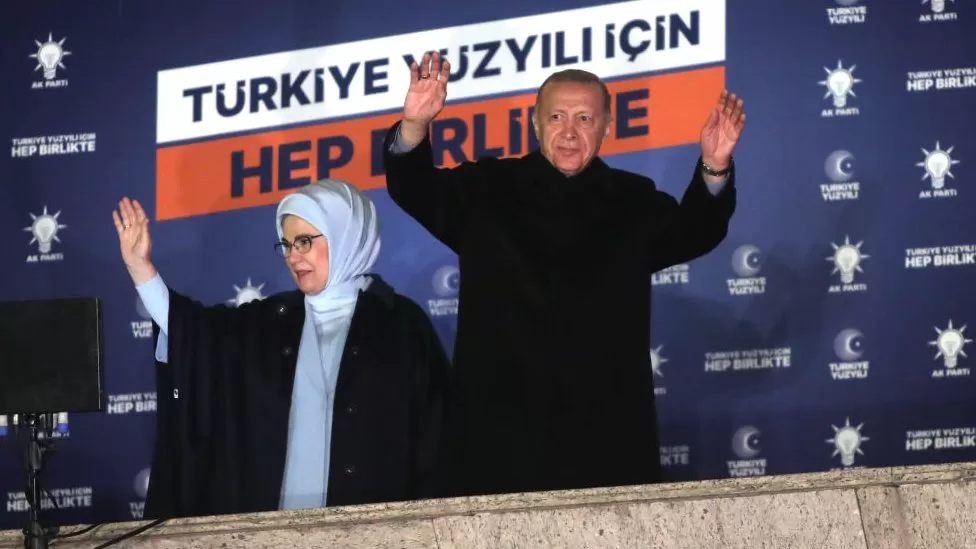
After 20 years in power, Recep Tayyip Erdogan stood on the balcony of his party HQ saying he was convinced he would win another five.

Everything appeared to have fallen into place for his opponent Kemal Kilicdaroglu to win.

But incomplete results put him behind the president in the first round.

And Mr Erdogan’s alliance could also be heading for a majority in parliament.

For months, Turkey’s disparate opposition parties had pooled their resources in a bid to bring an end to a president who has extended his power dramatically since a failed coup against him in 2016.

The election is being watched very closely in the West, because Mr Kilicdaroglu has promised to revive Turkish democracy as well as relations with its Nato allies. On the other hand, President Erdogan’s Islamist-rooted government has accused the West of plotting to bring him down.

In the early hours of Monday, Mr Kilicdaroglu stood on a stage at his party headquarters in Ankara, flanked by his allies but appearing less confident than before.

“If our nation says second round, we will absolutely win in the second round,” he said.

Mr Kilicdaroglu and his allies put on a show of unity as the results came in

Supporters outside party headquarters chanted one of his slogans, “everything will be all right”, but it was not clear for them that it would.

He had earlier angrily accused the government of seeking to “block the will of the people”, by launching repeated challenges in opposition strongholds. Two rising stars in the party, the mayors of Istanbul and Ankara, reminded voters that this was a strategy that Mr Erdogan’s AK Party had used before.

They praised an enormous team of opposition volunteers guarding ballot papers to ensure nothing untoward happened to the votes.

Mr Kilicdaroglu, 74, has lost several elections as leader of his Republican People’s Party, but this time his message of scrapping the the president’s excessive powers struck a chord.

Turks have also been reeling from a cost-of-living crisis with 44% inflation, made only worse by Mr Erdogan’s unorthodox economic policies.


And then the Erdogan government was blamed for a slow rescue response to the double earthquakes in February which killed more than 50,000 people in 11 provinces.

And yet, despite a very difficult few months, Turkey’s dominant president appears to have the upper hand.

Addressing supporters from the balcony he had used for previous victories he announced that “even though the final results are not in, we are far ahead”.

1px transparent line

Whether or not he does take a lead into an expected run-off two weeks ahead, the president appears to have defied many pollsters who said his rival had the edge and could even win outright without a run-off.

He could also be heading for a majority in parliament, along with his nationalist MHP ally, according to unconfirmed results quoted by state news agency Anadolu.

His supporters ridiculed the opposition allies first for declaring that Mr Kilicdaroglu would become the 13th Turkish president, and then for gradually lowering their expectations as the night progressed.

Pro-Erdogan celebrations went on well into the night in the biggest city Istanbul

What this result does confirm is the extent to which Turkish society has become polarised, 100 years since Kemal Ataturk’s foundation of the modern Turkish republic.

In the final hours before voting began, Mr Kilicdaroglu rounded his campaign off with a trip to Ataturk’s mausoleum in Ankara.

President Erdogan instead chose to make a very symbolic statement to his conservative and nationalist support base, by making a campaign speech at Hagia Sophia in Istanbul. Ataturk had turned the former Orthodox Cathedral into a museum, but in 2020 Mr Erdogan made it a mosque.

It is unclear how close the expected run-off will be, and there is already considerable speculation over what will happen to the 5% of votes that went to the third candidate in the election, ultranationalist Sinan Ogan.

He knows both leaders will be trying to court him and is bound to set some tough conditions.

It is far from certain that even if he does endorse either candidate the first-round voters he attracted will do the same.9

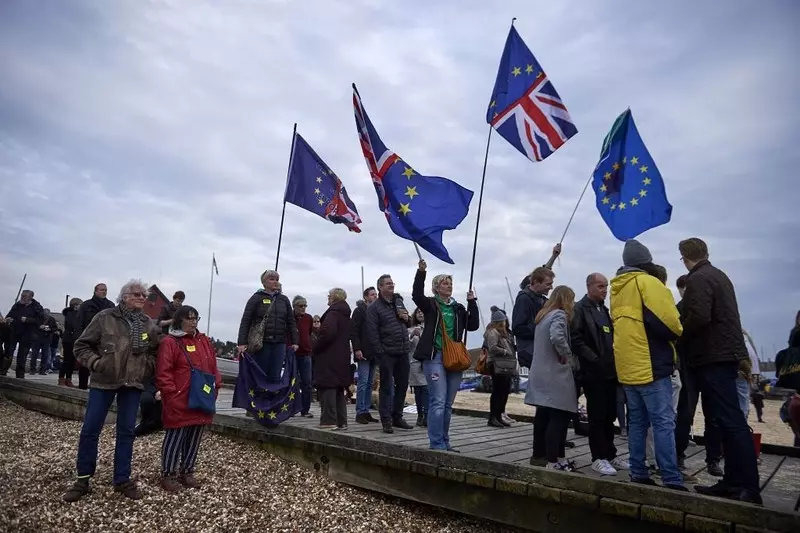
Labour is considering extending voting rights to some EU citizens living in the UK if the party wins the next general election.

The party is working on a package of proposals, including votes for some EU nationals and 16 and 17-year-olds in general elections.

In 2020, Labour’s leader Sir Keir Starmer called for all EU nationals to be given full voting rights in the UK.

But Labour said no final policy decisions had been made.

Labour’s shadow business secretary, Jonathan Reynolds, said the party’s policy on the issue had been the subject of speculation and discussions about this were “part of our manifesto process”.

“We do want to strengthen our democracy,” Mr Reynolds told the BBC’s Sunday with Laura Kuenssberg programme. “We believe if people make a contribution to this country, if they live here, there’s an argument for having them involved in [the democratic] process.”

The Conservative Party said Labour’s plan to give foreign nationals the vote at parliamentary elections “is laying the groundwork to drag the UK back into the EU by stealth”.

“The right to vote in parliamentary elections and choose the next UK government is rightly restricted to British citizens and those with the closest historical links to our country,” Conservative Party Chairman Greg Hands said.


Currently, EU nationals who are legally resident in the UK can vote in local and devolved elections but not general elections.

A Labour source said the party was thinking about proposals “that will enable people who live and contribute long-term to our society to be able to have their say in how the country is governed”.

The source said Sir Keir believes it is “fair and right” to give those people a voice in elections.

But the source said the details of the proposals have not yet been decided, despite suggestions made in newspaper reports by the Financial Times and the Sunday Telegraph.

There are an estimated 3.4 million EU nationals with settled status in the UK, and a further 2.7m with pre-settled status.

Settled status allows EU citizen to continue to live, work and study in the UK on an indefinite basis, while pre-settled status is a grant of temporary residence for five years.

The idea of extending the franchise to more EU nationals in the UK is controversial, with the Conservatives branding such a move “an attempt to rig the electorate to re-join the EU”.

When Sir Keir was running to be Labour leader in 2020, he said the “government should give all three million EU nationals living in the UK full voting rights in future elections”.

“We were never just ‘tolerating’ EU citizens living in this country – they are our neighbours, friends and families,” Sir Keir wrote in an op-ed for the Guardian. “To see their status in doubt devastates our sense not just of justice but also of fellowship.”


Extending the franchise to more EU nationals in the UK is a controversial idea

Labour’s 2019 manifesto included a commitment to “oversee the largest extension of the franchise in generations” by lowering the voting age to 16 and giving “full voting rights to all UK residents”.

As the party looks ahead to the next general election, it is deciding what reforms on voting rights to propose in its manifesto.

The BBC has been told Labour’s package of proposals will include the introduction of votes for 16- and 17-year-olds, in line with Scotland and Wales.

At the moment, 16 and 17-year-olds are allowed to vote in elections for the Scottish and Welsh devolved parliaments, but cannot vote in general elections.

A commitment to lower the voting age to 16 was included in both Labour’s 2015 and 2017 manifestos.

The Greens and the Liberal Democrats also support lowering the voting age.

Pakistan Army denies impression of imposing martial law, dispels rumours of disunity

The military Friday refuted reports of martial law’s imposition in the country after an almost four-day political turmoil erupted due to Pakistan Tehreek-e-Insaf (PTI) Chairman Imran Khan’s arrest, in which army’s installations were also targeted.

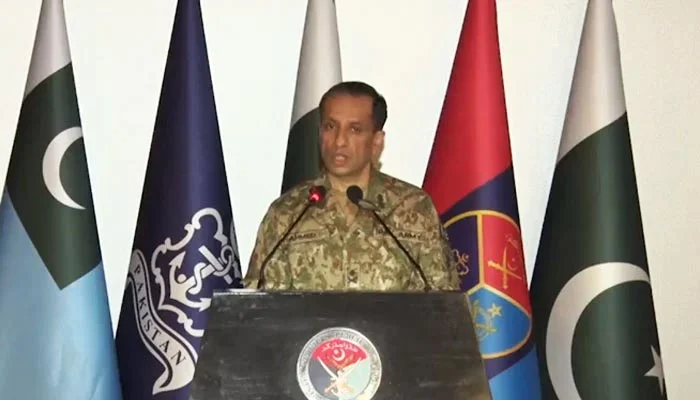
“I want to say very clearly that General Asim Munir and the army’s leadership wholeheartedly support democracy and will continue to do so. The imposition of martial law is out of the question,” Inter-Services Public Relations (ISPR) Director General Major General Ahmed Sharif Chaudhry told Geo News’ Shahzeb Khanzada.

“The army chief and the army’s senior leadership completely believe in democracy,” the military’s top spokesperson said.

In response to the reports which were circulating that army officers have resigned due to the ongoing chaos, the spokesperson snubbed these speculations as well.

“Despite all-out efforts of internal miscreants and external enemies, the army remains united under Chief of Army Staff General Asim Munir,” Maj Gen Chaudhry said.

“The dreams of creating division within the army will remain dreams. Neither anyone has resigned nor disobeyed any order,” the army’s spokesperson added.

The statement comes after Khan criticised the military and his supporters raised the stakes by attacking military targets — torching the residence of the corps commander in Lahore and attacking the entrance to the army’s headquarters in Rawalpindi.

Violent protests took place following Khan’s arrest, in which nearly a dozen people were killed and several injured. The law enforcement agencies then began a crackdown on PTI, arresting scores of workers and top leaders.

After the supporters attacked army installations, the ISPR said that May 9, 2023 — the day when chaos gripped the nation following Khan’s arrest — would go down in history as a “dark chapter”.

The ISPR called the PTI leaders “hypocrites” for inciting their workers against the armed forces on the one hand, and praising the military — in a bid to overshadow their criticism — on the other.

The unrest in the country has come to a halt for now as the Islamabad High Court (IHC) has provided blanket relief to Khan and barred authorities from arresting the PTI chief till Monday morning (May 15), after which, the government said it could arrest him, “if need be”.

In response to Khan’s fresh salvo against the army chief, Prime Minister Shehbaz Sharif said the PTI chairman’s latest statement against Gen Munir depicted his “cheap mentality” towards the armed forces.

“His statement proves that he is the mastermind of May 9 events,” the premier said in a statement, criticising Khan’s “baseless” allegations against a senior army official for planning to have him assassinated.

Pakistan’s ex-prime minister Imran Khan has left court premises in Islamabad, a day after the Supreme Court ruled his dramatic arrest on corruption charges was illegal.

On Friday evening, Mr Khan’s party said he was heading for the city of Lahore.

Judges granted Mr Khan protected bail, meaning he can not be re-arrested on those charges for two weeks.

The court also ordered he could not be arrested on any charges filed after last Tuesday until 17 May.

Despite the rulings, the corruption charges against Mr Khan still stand.

“The head of the country’s largest party was abducted, kidnapped from the high court, and in front of the entire nation,” Khan told AFP from the court building.

“They treated me like a terrorist, this had to have a reaction,” he said of the protests that followed.

Mr Khan remained within court premises after the hearing on Friday seeking preventive bail against other charges, which he told the BBC included counts of terrorism, sedition and blasphemy.

Conviction would disqualify the former international cricket star – and Pakistan’s prime minister from 2018 to 2022 – from standing for office, possibly for life. Elections are due later this year.

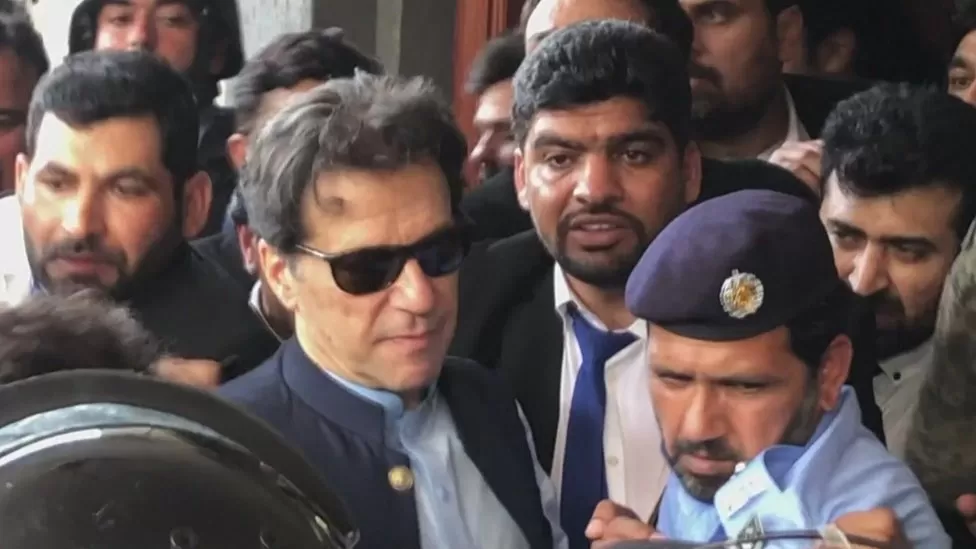
Mr Khan had arrived at the hearing under heavy armed guard, and greeted supporters with a single raised fist.

Speaking during Friday’s hearing, Chief Justice Umar Ata Bandial said the arrest was unlawful because it took place on court premises.

He ordered that the “whole process” of Mr Khan’s arrest “needs to be backtracked”.

The 70-year-old – who was arrested on Tuesday as he arrived at a courthouse in Islamabad – pleaded not guilty to the charges when a judge formally indicted him with corruption for the first time in the dozens of cases he faces.

Officials say Mr Khan unlawfully sold state gifts during his premiership, in a case brought by Pakistan’s Election Commission.

Imran Khan was surrounded by a crowd of people as he left court on Friday

The dramatic saga has significantly escalated tensions between Mr Khan and Pakistan’s powerful military.

Many analysts believe Mr Khan’s election win in 2018 happened with the help of the military, which both parties denied.

But he later fell out with the army. After a series of defections, and amid mounting economic crises, he lost his majority in parliament.

Since being ousted less than four years into his term, he has become one of the military’s most vocal critics, and analysts say the army’s popularity has fallen.

And his PTI party says the charges against him – which relate to gifts given to him by foreign leaders while he served as prime minster – are politically motivated.

Watch Tuesday’s dramatic arrest of Pakistan’s former prime minister

His dramatic arrest outside the courthouse on Tuesday sparked outrage among Mr Khan’s supporters.

At least 10 people were killed and some 2,000 arrested as unrest swept the country. Those protests included an attack at a military commander’s home residence in Lahore, which was set on fire.

While this week’s violence petered out after the army was deployed in Islamabad and other areas, such as Punjab and Khyber Pakhtunkhwa, the country remains on edge.

Critics say the PTI has been fuelling unrest through social media posts calling for protesters to take to the streets, and judges told Mr Khan that he must condemn the violence and tell supporters to stop.

Mr Khan says he and his party only call for peaceful protest.

Pakistan’s current Prime Minister Shehbaz Sharif, who took power after Khan was ousted, criticised the Supreme Court’s ruling to free Khan in a cabinet speech aired on state TV.

He alleged that judges had favoured Imran Khan, and their ruling had caused “the death of justice in Pakistan”.

He further criticised Mr Khan and his party for their inflammatory language and encouraging protesters to take to the streets.

“Imran Khan has divided the nation,” he said.

Israel has killed a sixth senior leader of Palestinian Islamic Jihad (PIJ) in an air strike in the Gaza Strip, as fighting between them escalated.

It said Iyad al-Hassani had directed the militant group’s operations since his predecessor was killed on Tuesday.

Friday’s strike, which medics said also killed another person, followed a barrage of rockets fired from Gaza, some of which reached near Jerusalem.

The chances of an imminent ceasefire appeared slim after the exchange.

However, a Palestinian official familiar with the talks taking place in Egypt told the BBC that Egyptian officials “presented this evening a new proposal for a ceasefire, which is being studied now”. Egypt was also waiting for Israel’s response, they added.

At least 33 Palestinians in Gaza have been killed – about half of them civilians – since Israel carried out a series of air strikes early on Tuesday that killed three top PIJ commanders, the Palestinian health ministry there says. Another 147 people have been wounded.

One Israeli civilian has been killed and five wounded by Palestinian rocket fire in the same period, Israel’s Magen David Adom ambulance service says.

The fighting which resumed on Friday came after 12 hours of relative calm, during which there were several Israeli air strikes but no Palestinian rocket attacks.

Around midday PIJ militants launched dozens of rockets. Some were aimed towards the Jerusalem area, about 65km (40 miles) from Gaza.

The Israeli military said two rockets heading to Jerusalem were intercepted, but another rocket reportedly landed in an open field near the Jewish settlement of Bat Ayin in the occupied West Bank, about 16km south of the city.

PIJ said “the firing of rockets at Jerusalem is a message, and everyone should understand its aim”.

Targeting Jerusalem, which Israel considers its capital, is meant to signal to Israel that the group is prepared to connect events in the city to those in Gaza.

It is the first time rockets have landed near there since a 10-day conflict between Israel and militants in Gaza in May 2021.

Israel responded to Friday’s rocket fire with intensive air strikes.

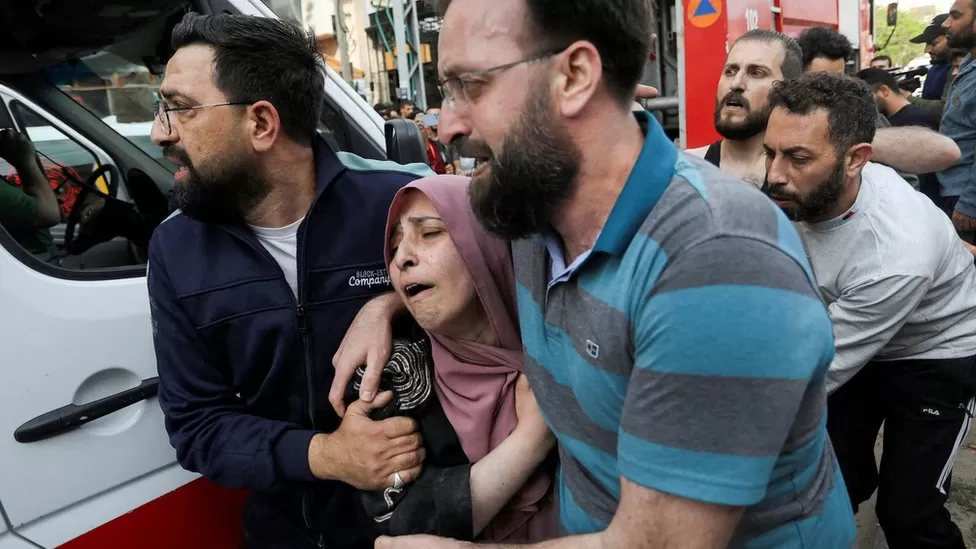
Warplanes hit a multi-storey residential building in the northern Nasser area of Gaza City, killing two people. Five others were wounded, including a child, according to rescuers.

A PIJ spokesman confirmed the death of Iyad al-Hassani, according to AFP news agency.

Sources said Hassani was deputy head of Islamic Jihad’s armed wing and the most senior figure in the group to be targeted by Israel so far in the fighting.

Israel’s air force said Hassani had replaced Khalil al-Bahtini, who was killed on Tuesday, as PIJ’s “commanding officer of the operation in the Gaza Strip” and described him as a “significant figure”.

The identity of the second person was not immediately clear, but the air force described them as a PIJ “operative”.

An Israeli official told the BBC hitting the senior chain of command was also meant as a warning to Hamas, the dominant armed group in Gaza, which so far is thought to have stayed on the sidelines of the current escalation.

More rockets were fired at southern Israeli communities following the strike and Israel said there was likely to be more long-range fire in response to what it called the “targeted killing” of Hassani.

On Thursday, another two top PIJ commanders – the head of its rocket launching force and his deputy – were killed in Israeli strikes in southern Gaza.

Rockets reached a block of settlements south of Jerusalem on Friday

This week’s fighting is the heaviest since three days of hostilities between Israel and PIJ last August, in which 49 Palestinians were killed in Gaza.

At least 973 rockets and mortars have been fired from Gaza over the past four days, with 761 crossing into Israeli territory, according to the military. Most have been intercepted or have landed in open areas.

The military says 181 of the rockets fell short inside Gaza and that they have killed four people there, including three children. Islamic Jihad denies the allegation.

The military also says its strikes have hit 254 PIJ targets in Gaza. According to Gaza’s housing ministry, 28 homes have been destroyed, 37 damaged so badly that they are uninhabitable, and 495 partly damaged.

Meanwhile, a British surgeon stranded in Gaza has told the BBC that more than 140 “desperately sick” patients there, most of whom have cancer, are being denied urgently-needed treatment while the crossing to Israel remains shut for a fourth day.

“The doctors I work with here have got multiple examples of people who are in desperate need of cancer treatment,” Professor Nick Maynard said.

“These treatments are undoubtedly being delayed and potentially leading to deaths because of the delays now,” he added.

Turkey’s all-powerful President Erdogan is in the fight of his life against an opposition that has united against him for Sunday’s elections.

His main rival Kemal Kilicdaroglu appeared before a throng of supporters on Friday, flanked by allies from across the political spectrum who have come together as never before.

As the rain beat down in Ankara, he vowed to restore “peace and democracy”.

The man he wants voters to oust after 20 years – Recep Tayyip Erdogan – said he had kept Turkey standing tall despite many challenges, including the economy with its rampant inflation and February’s catastrophic double earthquakes.

Both issues have dominated this febrile campaign for both the presidency and parliament.

At 74, the opposition leader is often described as soft-spoken, but he gave a powerful speech to an audience that believes this is their best hope so far of reclaiming power from a president who has taken it away from parliament and increased his own dramatically.


Kemal Kilicdaroglu told supporters in the pouring rain he was ready to become president

Mr Kilicdaroglu is slightly ahead in the opinion polls and his supporters have dared to dream he might win outright on Sunday, with more than 50% of the vote, rather than face a run-off two weeks later.

Firat, one of five million first-time voters, said he was delighted at conservatives and nationalists appearing on the same platform as the head of the centre-left Republican People’s Party (CHP).

Here was nationalist Meral Aksener, the only female leader in the six-strong alliance, and there was Temel Karamollaoglu, who fronts the pro-Islamist Felicity party.

Mr Kilicdaroglu’s party is secular to the core, but he has worked hard to reach out to women who wear the headscarf. The six parties have rallied under the slogan Haydi (Come on!) and a campaign song of the same name.


Firat (R), with his sister and mother at the opposition rally, praised the opposition’s unity

Tensions are running so high ahead of the vote that he wore a bullet-proof vest on stage in Ankara for his final rally and at another event earlier on.

The race has become as tense as it is pivotal. One of the four candidates for the presidency, Muharrem Ince, pulled out on Thursday, complaining that he had been targeted on social media with deepfake sex videos that had “manipulated the electorate”.

When the main opposition challenger blamed Russia, the Kremlin denied having anything to do with the videos or seeking to interfere in the vote.

Mr Erdogan, who has maintained ties with Vladimir Putin, warned his rival: “If you attack Putin, I will not be ok with that.”

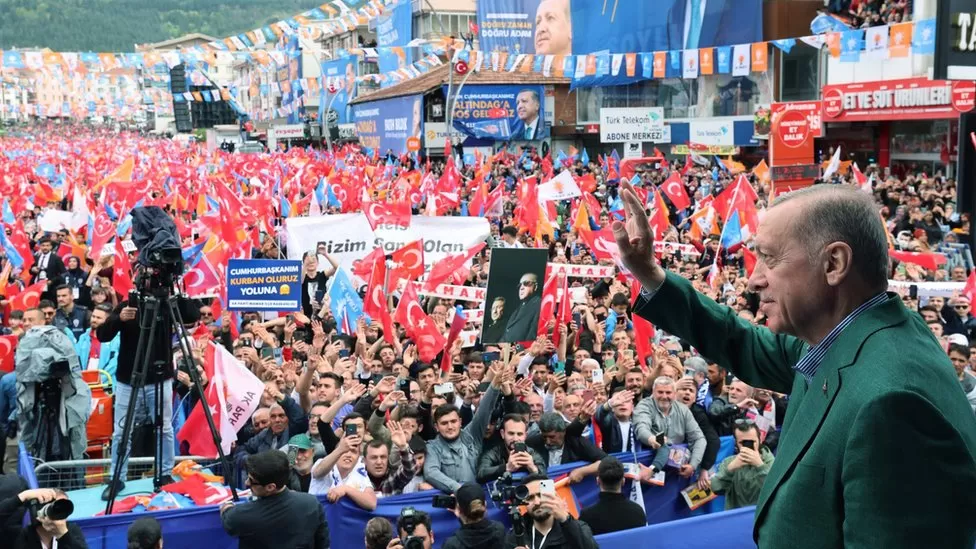
The president was addressing party loyalists in Istanbul, but the night before he was just outside the capital in a city of half a million people that seemed in full support of his AK Party.

Orange, blue and white party AKP flags fluttered throughout the centre of Sincan, as locals filled the streets in the hope of catching a glimpse of Mr Erdogan.

Streets around the Erdogan rally in Sincan were filled with supporters

Supporters chanted party songs as they waited for the president to show on stage in a green jacket. One chorus rang out repeatedly Re-cep Tay-yip Er-do-gaaaan.

“We built schools, universities and hospitals… we changed the face of our cities. We extracted our own natural gas and oil,” Erdogan told thousands of cheering supporters.

His strategy, first as prime minister but then as president, has been to build growth, often through big-ticket construction projects that are visible in many of the big cities, but not so obvious in Sincan.

President Erdogan was greeted by a mass of adoring supporters in Sincan

Although his party still commands strong support, he relies on the backing of the nationalist MHP and other smaller groups in his People’s Alliance.

His greatest support comes mainly from conservative or nationalist Turks, and he has aimed his rhetoric not just at the West, which he accuses of going against him, but at the LGBT community too.

“The AK Party does not allow LGBT people into its neighbourhood, and the MHP does not allow them into the People’s Alliance, because we believe in the sanctity of a family.”

These political alliances have become essential under Turkey’s political system as a party needs 7% of the national vote to get into parliament, or be part of an alliance that does.

Whoever wins the presidency will need to have sufficient support in parliament to back their plans.


On the campaign trail in Ankara, centre-left candidate Aysun Palali Koktas said that while the economy and the aftermath of the earthquake were the top two issues of the election, the future of Turkey’s democracy and people’s rights were just as important.

“When we tweet, we don’t want to be frightened, and that’s the case especially for young people,” she said.

But, AK Party candidate Zehranur Aydemir, 25, believes young voters are very well treated by the government. “You can see young people at every level in our party.”

More than 64 million people are expected vote at home and abroad on Sunday.

To win outright a candidate will have to secure more than half the vote.

If no candidate gets at least 50% plus one vote in the first round, the presidential election will go to a second round on 28 May between the two who received the most votes.