PM’s youth loan scheme: Here’s a step-by-step registration guide

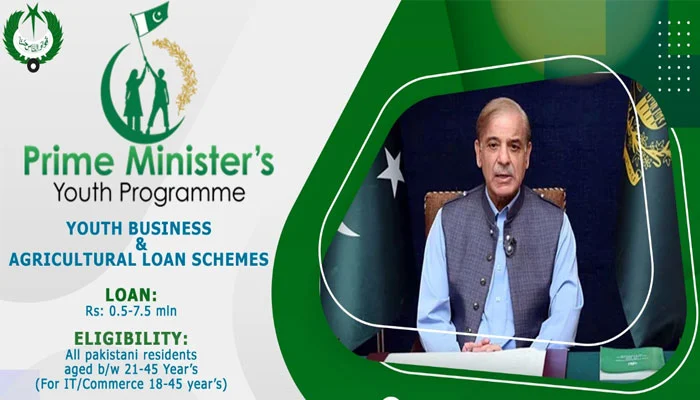
Prime Minister Shehbaz Sharif on Tuesday launched Youth Business and Agricultural Loan Schemes in Islamabad, aimed at promoting self-employment and entrepreneurship amongst the youth.

People in the age group of 21 and 45 years can avail of the loan facility of up to Rs7.5 million under the schemes. For IT and e-commerce businesses, the lower age limit is 18 years.

Premier Shehbaz further said that the loan “schemes are aimed at making the youth self-reliant”.

Here are the step-by-step guidelines to apply for the loans:


The addition of agricultural loans will help the rural youth in bringing innovation to farming which can include mechanised farming, the creation of agricultural value chains and the solarisation of farming equipment to create more sustainable energy resource management in a climate-challenged country like Pakistan.

Microfinancing through small business loans will promote a norm of job creation rather than job seeking among the country’s youth bulge.

Islamic banking facilities can also be availed on the loan scheme.

25% quota has been reserved for women.

The prime minister also added that under the schemes, loans of up to Rs1.5 million can be availed on the personal guarantee of the borrower.

“There will be no interest rate on the loan of up to Rs0.5 million. 5% interest will be charged on the loan of over Rs0.5 million to 1.5 million,” he said, adding, “7% interest rate will be charged on the loan of over Rs1.5 million to Rs7.5 million.”

Speaking on the occasion, State Bank of Pakistan (SBP) Governor Jameel Ahmad said that “special instructions had been issued to the banks for issuing loans to the youth”.

Provision of loans to the “agriculture sector is the top priority” of the government and the central bank, he added. The SBP governor said that every possible assistance would be provided to farmers in flood-hit areas. “The limit of agricultural loans has been increased by 44%.”

He urged all institutions to play a positive role in connection with the youth loan scheme.

Pakistan, India were on verge of nuclear war after Balakot incident: Pompeo

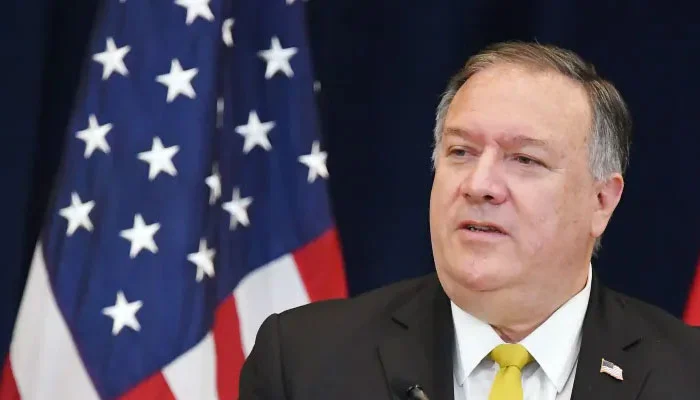
WASHINGTON: Former US secretary of state Mike Pompeo wrote in a book published Tuesday that India and Pakistan came close to nuclear war in 2019 and that US intervention prevented escalation.

“I do not think the world properly knows just how close the India-Pakistan rivalry came to spilling over into a nuclear conflagration in February 2019,” the likely future presidential contender wrote in “Never Give an Inch,” his memoir of his time as Donald Trump’s top diplomat and earlier CIA chief.

India in February 2019 broke precedent by launching airstrikes inside Pakistani territory after blaming a militant group in Balakot for a suicide bombing that killed 41 Indian paramilitary soldiers in the Indian Illegally Occupied Kashmir (IIOJK). In response, Pakistan shot down an Indian warplane that intruded into its territory and captured the pilot.

Pompeo, who was in Hanoi for a summit between Trump and North Korean leader Kim Jong Un, said he was woken up with an urgent call from a senior Indian official.

“He believed the Pakistanis had begun to prepare their nuclear weapons for a strike. India, he informed me, was contemplating its own escalation,” Pompeo wrote.

“I asked him to do nothing and give us a minute to sort things out,” Pompeo said.

Pompeo said that US diplomats convinced both India and Pakistan that neither was preparing to go nuclear.

“No other nation could have done what we did that night to avoid a horrible outcome,” Pompeo wrote.

Pompeo said he spoke to “the actual leader of Pakistan,” then army chief General Qamar Javed Bajwa in an attempt to avert the crisis.

Pompeo at the time publicly defended India’s right to act. In his book, Pompeo spoke highly of India and, unlike officials in New Delhi, made no secret of his desire to ally with the South Asian democracy “to counteract Chinese aggression.”

‘I’m still trying to kill you’

Pompeo writes extensively in the book of his diplomacy with Kim Jong Un, which included preparing three meetings between the young totalitarian leader and Trump.

He recalled a chilling first conversation as he flew into Pyongyang in March 2018 on a clandestine trip as CIA director.

“‘I didn’t think you’d show up. I know you’ve been trying to kill me,'” Pompeo quotes Kim as telling him.

“I decided to lean in with a little humor of my own: ‘Mr. Chairman, I’m still trying kill you.'”

But Pompeo described a budding understanding with Kim as the Trump administration offered incentives to lower tension.

Pointing to Kim’s smoking habit, Pompeo wrote that he told Kim he would take him to “the nicest beach in Miami and smoke the best Cubanos in the world. He told me, ‘I already have a great relationship with the Castros.’ Of course, he did.”

As for their substantive conversation, Pompeo said Kim spoke candidly on concerns about China, usually viewed as North Korea’s main ally.

Told that China believes North Korea wants US forces out of South Korea, “Kim laughed and pounded on the table in sheer joy, exclaiming that the Chinese were liars.”

Kim “said that he needed the Americans in South Korea to protect him from the CCP, and that the CCP needs the Americans out so they can treat the peninsula like Tibet and Xinjiang,” Pompeo wrote, referring to the Chinese Communist Party.

Pompeo became known for his hawkish stance on China, controversially accusing Beijing of spreading the “Wuhan virus.”

He said that Trump told him with an epithet that Chinese President Xi Jinping “hates you” and asked Pompeo to “shut the hell up for a while” as the United States needed health care equipment from China.

Pompeo has not ruled out running against Trump for the 2024 Republican presidential nomination, although early polls show little support for Pompeo.

Turkiye postpones Nato talks with Sweden, Finland

A Turkish diplomatic source said the tri-party meeting has been pushed back from February to a “later date”, without providing further details.

The decision further diminished the chances of the two countries joining Nato before Turkiye’s May presidential and parliamentary elections.

Finland, which shares a 1,300-kilometre border with Russia, and Sweden decided jointly to end their decades-long policies of military non-alignment, winning formal support for their plans at a historic Nato summit in June.

The two countries bids’ were then swiftly ratified by 28 of Nato’s 30 member states, highlighting the issues’ urgency in the face of Russia’s aggression. Bids to join Nato must be ratified by all members of the alliance, of which Turkiye is a member.

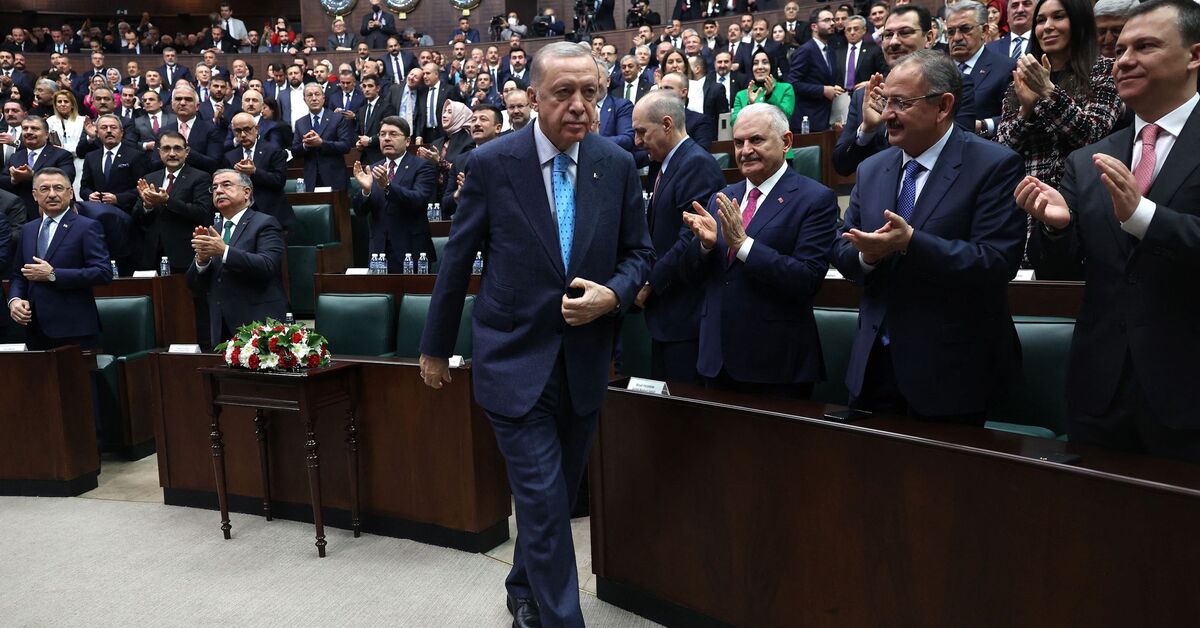
Hungarian Prime Minister Viktor Orban has promised that his parliament would approve the two bids next month. But Mr Erdogan has dug in his heels heading into a close presidential election in which he is trying to energise his nationalist electoral base.

Mr Erdogan’s resistance prompted Finland to hint for the first time on Tuesday that it may try to join on its own because of Stockholm’s diplomatic problems with Ankara.

“We have to assess the situation, whether something has happened that in the longer term would prevent Sweden from going ahead,” Finnish Foreign Minister Pekka Haavisto told broadcaster Yle.

Permanently barred

Sweden’s Foreign Minister Tobias Billstrom said he was “in contact with Finland to find out what this really means”.

Mr Haavisto later clarified his comments, saying he did not want to “speculate” on Finland joining alone “as both countries seem to be making progress”, and emphasising their commitment to a joint application.

But “of course, somewhere in the back of our minds, we are thinking about different worlds where some countries would be permanently barred from membership”, he said.

Mr Haavisto said the anti-Turkiye protests had “clearly put a brake on the progress” of the applications by Finland and Sweden.

“My own assessment is that there will be a delay, which will certainly last until the Turkish elections in mid-May”, Haavisto said.

‘Plan B’ out in the open

Turkiye has indicated that it has no major objections to Finland’s entry into Nato.

Helsinki had refused until now to speculate on the option of joining without Sweden, emphasising the benefits of joint membership with its neighbour.

But “frustration has grown in various corners of Helsinki”, and “for the first time it was said out loud that there are other possibilities”, Matti Pesu, a researcher at the Finnish Institute of International Affairs, said.

“There has been a change” in the Finnish position, he said. “These Plan B are being said out loud.” Mr Pesu noted that while Turkiye had so far given no indication it would treat the two applications “separately”, it will be “interesting to see how Turkiye reacts” to Mr Haavisto’s comments.

At least 124 people died in freezing temperatures in Afghanistan in the past fortnight, Taliban officials say.

About 70,000 livestock had also perished in what is the coldest winter in a decade, a State Ministry for Disaster Management spokesman said.

Many aid agencies suspended operations in recent weeks after the Taliban banned Afghan women from working for non-governmental organisations.

A Taliban minister said despite the deaths, the edict would not be changed.

Acting Minister of Disaster Management Mullah Mohammad Abbas Akhund told the BBC that many areas of Afghanistan were now completely cut off by snow; military helicopters had been sent to the rescue, but they couldn’t land in the most mountainous regions.

The acting minister said the forecast for the next 10 days indicated temperatures would warm. But he was still worried about a rising death toll – of Afghans, and their livestock.

“Most of the people who lost their lives to the cold were shepherds or people living in rural areas. They didn’t have access to healthcare,” Mullah Akhund said.

“We’re concerned about those who are still living in the mountain regions. Most of the roads which pass through the mountains have been closed due to snow. Cars have got stuck there and passengers have died in the freezing temperatures.”

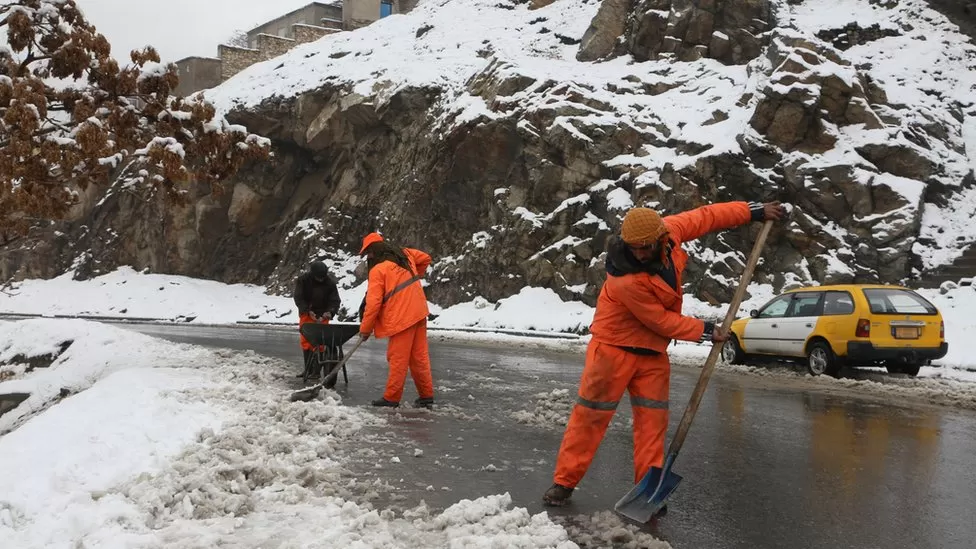
Workers kept this Kabul road open, but many mountain areas are cut off by snow

Winters are always harsh here in Afghanistan but this is the worst weather in a decade.

And this year’s relief operations are hampered by last month’s Taliban government edict barring Afghan women from working in aid agencies.

But Mullah Akhund was categorical. This edict could not be lifted – the international community, he insisted, had to accept Afghanistan’s Islamic culture.

“Men are already working with us in the rescue effort and there is no need for women to work with us. The men from every family are already participating in relief efforts, so there’s no need for women,” he told the BBC.

Aid officials, including the United Nations, are urgently trying to find ways to work around this ban.

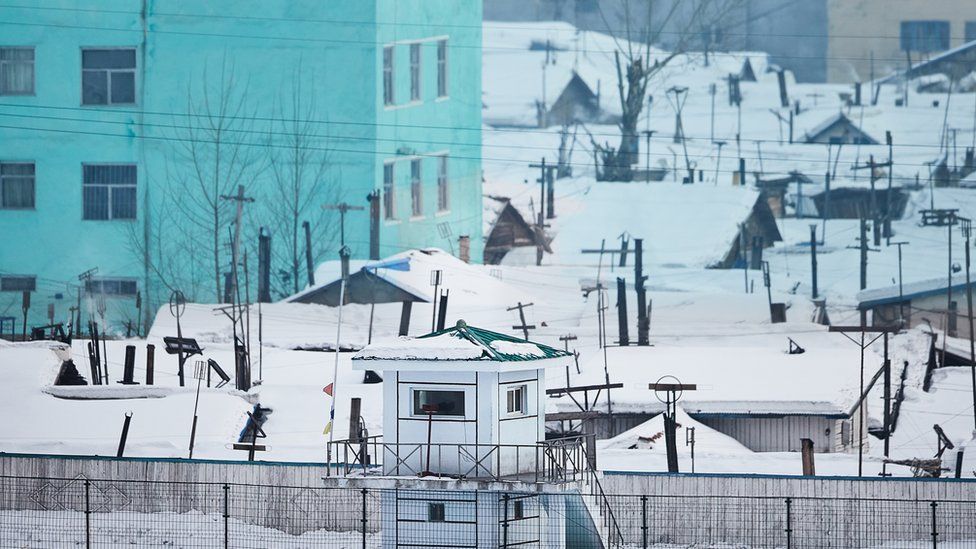
North Korean authorities have warned of extreme weather conditions in the country as a cold wave sweeps the Korean peninsula.

Temperatures are likely to dip below -30C in the northern regions, which are also the poorest part of the country, the state radio broadcaster said.

Coastal areas are also expected to see high winds, according to state media.

South Korea too has issued a cold wave warning and northern China has been experiencing record low temperatures.

Temperatures are also expected to drop to their lowest in a decade in Japan this week.

While North Korea has been affected by extreme or adverse weather much like other places, little is known about the impact of this on its people.

Ryanggang, North Hamgyong and South Hamgyong, the country’s poorest provinces and those expected to be most vulnerable to climate shocks, are all located in the north.

Electricity is uncommon outside the capital Pyongyang, and households in these places burn wood, and dried plants for warmth during the winter, NK News has reported.

It also says many merely use plastic wrap around their doors and windows for insulation.

Radio Free Asia reported in December that “large numbers” of people in the country had gone missing late last year during another extremely cold spell.

Many are thought to have starved or frozen to death, as the mercury dipped below freezing and food became scarce.

Food insecurity in North Korea is said to be at its worst since a widespread famine in the 1990s, according to Lucas Rengifo-Keller, a research analyst at Peterson Institute for International Economics in the US.

Scientists say extreme weather, including cold waves, is becoming more common because of climate change.

Tuesday’s cold wave alerts come as Pyongyang prepares to celebrate the 75th anniversary of the Korean People’s Army next week.

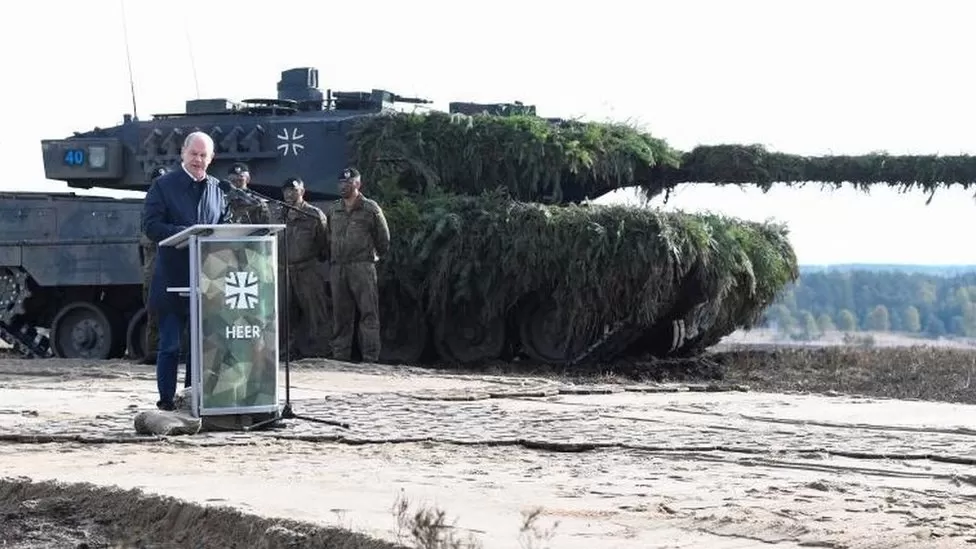
After months of reluctance, the US and Germany reportedly plan to send tanks to Ukraine, in what Kyiv hopes will be a game-changer on the battlefield.

US President Joe Biden’s administration is expected to announce plans to send at least 30 M1 Abrams tanks.

German Chancellor Olaf Scholz has also reportedly decided to send at least 14 Leopard 2 tanks.

Russia’s ambassador to the US blasted the news as “another blatant provocation”.

Ukrainian officials have said such shipments could help its forces seize back territory from the Russians.

Until now, the US and Germany have resisted internal and external pressure to send their tanks to Ukraine.

Washington has cited the extensive training and maintenance required for the high-tech Abrams.

Berlin has expressed caution about Nato becoming a direct party to the war with Russia.


Citing anonymous sources, US media outlets are reporting that an announcement regarding Abrams shipments to Ukraine could come as soon as Wednesday.

Unnamed officials were cited as saying at least 30 of the vehicles could be sent.

The timeline of any potential delivery, however, remains unclear, and it could take months or even years for the US combat vehicles to reach the battlefront.

According to US media reports, German officials had privately insisted they would only agree to the transfer of Leopard 2s to Ukraine if the US also sent M1 Abrams.

“If the Germans continue to say we will only send or release Leopards on the conditions that Americans send Abrams, we should send Abrams,” Democratic Senator Chris Coons, a Biden ally, told Politico on Tuesday.

Britain has already said it will send Challenger Two tanks to Ukraine.

Poland this week said it wants to send Leopard 2 tanks to Ukraine, but they are made in Germany and so Berlin needs to approve their export.

At least 16 European and Nato countries have the Leopard 2 tanks, according to the International Institute for Strategic Studies.

Not all will send tanks to Ukraine – but Mr Scholz’s apparent decision now means they can, should they wish.

Ukraine is still unlikely to get the 300 modern main battle tanks it says it needs to win the war.

But if half a dozen Western nations each provide 14 tanks, then that would bring the total to nearly a hundred – which could make a difference.

Western tanks – including the UK’s Challenger 2, Germany’s Leopard 2 and the US-made Abrams – are all seen as superior to their Soviet-era counterparts, like the ubiquitous T-72.

They will provide Ukrainian crews with more protection, speed and accuracy.

But Western modern main battle tanks are not a wonder weapon or game-changer on their own. It’s also what’s being supplied alongside them.

In recent weeks, there’s been a step change in heavy weapons being supplied by the West – including hundreds more armoured vehicles, artillery systems and ammunition.

Combined together, they are the kind of military hardware needed to punch through Russian lines and to retake territory.

If Ukrainian troops can be trained and the weapons delivered in time, they could form key elements of any spring offensive. A missing element for offensive operations is still air power.

Ukraine has been asking for the West to provide modern fighter jets since the war began. So far, none has been delivered.

There has been no official statement from the German government yet. The chancellor is due to address the German parliament on Wednesday morning.

However, Marie-Agnes Strack-Zimmermann of the liberal FDP party, who chairs the defence committee of the German parliament, welcomed the reports.

“The decision was tough, it took far too long, but in the end it was unavoidable,” she said, adding that it would come as a relief to “the battered and brave Ukrainian people”.

Watch: Poland’s PM: “Free world cannot afford not to send Leopard tanks”

Allied nations had become frustrated at what they perceive as German reluctance to send the armoured vehicles in recent days.

German Defence Minister Boris Pistorius earlier said that Berlin had given other nations the green light to train Ukrainians to use Leopard 2 tanks, but did not commit to sending their own.

The Ukrainian president’s chief of staff, Andriy Yermak, on Tuesday called on Western countries to give Kyiv hundreds of tanks to form a “crushing fist” against Russia.

“Tanks are one of the components for Ukraine to return to its 1991 borders,” he wrote on Telegram after the reports emerged of Germany agreeing to send tanks.

Anatoly Antonov, the Russian ambassador to Washington, wrote on Telegram: “If the United States decides to supply tanks, then justifying such a step with arguments about ‘defensive weapons’ will definitely not work.

“This would be another blatant provocation against the Russian Federation.”

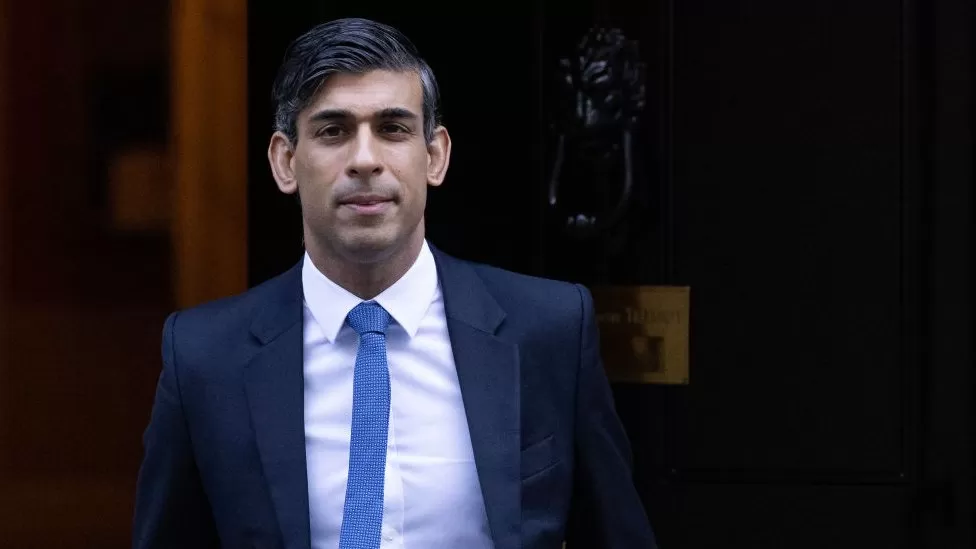
Rishi Sunak is likely to face more criticism at Prime Minister’s Questions as he resists calls to sack his party chairman Nadhim Zahawi.

Mr Sunak has ordered his ethics advisor to investigate how Mr Zahawi resolved a tax dispute when he was chancellor.

The PM has aid there are “questions that need answering” but it is unclear what he knew about Mr Zahawi’s dealings with HMRC when he appointed him.

Mr Zahawi maintains he behaved appropriately.

Last summer, Mr Zahawi dismissed reports of a HMRC investigation as “smears” and threatened some who intended to raise questions about his tax affairs with legal action.

This has drawn criticism not just from the opposition, but from Lord Evans, Chairman of the Committee on Standards in Public Life.

He told BBC Radio 4’s PM programme that the “apparent legal attempts to suppress this story” does not “live up to the sort of standards” the public would expect.


Senior Conservative MP Caroline Nokes has called for Mr Zahawi to “stand aside until this matter is all cleared up” but the prime minister has so far stood by him saying it is “longstanding practice” for ministers to remain in their roles while under investigation.

Mr Sunak ordered the investigation into Mr Zahawi’s tax affairs after it was revealed he had paid a penalty to settle his tax issue with HMRC.

The prime minister’s spokesperson suggested Mr Sunak was not aware last week that Mr Zahawi had paid a penalty.

That leaves questions for former Prime Minister Boris Johnson, who appointed Mr Zahawi chancellor last summer when the matter had not been resolved.

In a statement, Mr Zahawi said he welcomed the investigation and looked forward to “explaining the facts of this issue” to the No 10 ethics adviser Sir Laurie Magnus.

Labour has argued the prime minister should sack Mr Zahawi before the investigation concludes, calling it a “pathetic attempt to pass the buck”.

Downing Street sources have said they want to see the inquiry concluded swiftly.

Power breakdown in Pakistan: Despite passing of deadline, electricity yet to be fully restored

LAHORE/KARACHI/QUETTA/ISLAMABAD: The electricity has still not been fully restored across the country despite the passing of the government’s 10pm deadline, hampering businesses and the daily lives of more than 220 million people.

Prime Minister Shehbaz Sharif has ordered an inquiry into the outage, which began at around 7:30am and has so far lasted more than 16 hours during the peak winter season.

The outage occurred on a winter’s day when temperatures are forecast to fall to around 4 degrees Celsius (39°F) in Islamabad and 8 degrees Celsius (46°F) in Karachi.

The outage — which Energy Minister Khurram Dastagir had said was due to a voltage surge — is the second major grid failure in three months, and adds to the blackouts that Pakistan’s populace suffers on an almost-daily basis.

Analysts and officials blame the power problems on an ageing electricity network, which like much of the national infrastructure, desperately needs an upgrade that the government says it can ill afford.

As evening drew on and homes were without electricity in the dark, the energy minister wrote on Twitter that authorities had started restoring power across the country. Dastgir had told reporters earlier: “We have faced some hurdles but we will overcome these hurdles, and will restore the power.”

“Target is to restore power by 22:00 (10pm) local time but trying to restore much before that,” the minister had told Reuters, but later in the press conference said that the complete restoration would be done by tonight, without specifying the time.

Soon after the power breakdown was reported earlier in the day, Dastgir, while talking to Geo News, said that the power generation units are temporarily shut down in winter at night as an economic measure to save fuel costs.

“When the systems were turned on at 7:30am this morning one by one, frequency variation was reported in the southern part of the country between Jamshoro and Dadu.”

“There was a fluctuation in voltage and power generating units were shut down one by one due to cascading impact. This is not a major crisis,” said the federal minister.

The minister said that his ministry has started restoring some grid stations in Tarbela and Warsak.

“Peshawar Electric Supply Company (PESCO) and some grids of Islamabad Electric Supply Company (IESCO) have already been restored,” claimed the minister.

In a press conference later, he added that despite the unprecedented voltage fluctuations in the national grid, the transmission system is safe, which will help in the restoration of power.

“Our teams — from across the country — have not reported any adverse effects of the breakdown on the national transmission system. This will help us when we restore power.”

A shopkeeper speaks with a customer (not pictured) at a medical store during a country-wide power breakdown in Karachi, Pakistan January 23, 2023. — Reuters
A man sits outside his shop during a country-wide power breakdown in Karachi, Pakistan January 23, 2023. — Reuters
A man starts a generator outside his shop during a country-wide power breakdown in Karachi, Pakistan January 23, 2023. — Reuters
Volunteers of the Edhi Foundation, a non-profit social welfare programme, work at a communication and control room during a country-wide power breakdown in Karachi, Pakistan January 23, 2023. — Reuters
A man sits outside his shop during a country-wide power breakdown in Karachi, Pakistan January 23, 2023. — Reuters
A shopkeeper and a labourer are seen during a country-wide power breakdown in Karachi, Pakistan January 23, 2023. — Reuters
A shopkeeper speaks with a customer (not pictured) at a medical store during a country-wide power breakdown in Karachi, Pakistan January 23, 2023. — Reuters
A man sits outside his shop during a country-wide power breakdown in Karachi, Pakistan January 23, 2023. — Reuters
He added that a working power plant in Uch is providing energy to Sukkur, Naushahro Feroze, Larkana, Khairpur Nathan Shah, and their surrounding areas.

So, he said, using the same power plant, the power has been restored in some areas of Balochistan and South Punjab, while the Thar Coal facility is providing power to Karachi Electric so that it can restore its functions partially.

Talking about the breakdown in Karachi earlier, the minister had said that the matter in the port city is complicated as it has a complete electric supply system.

“All the officials are trying their level best to restore the system. We faced some difficulties in restoring the hydel power plants. As I had mentioned earlier that the national transmission system was safe, so we need the power to supply electricity further. ”

He added that the National Transmission & Despatch Company has been authorised to “use any power plant — no matter how expensive it might be to operate them — for the restoration of electricity”.

PM’s committee, NEPRA’s notice
Prime Minister Shehbaz Sharif took strict notice of the power outage and ordered the constitution of a high-level three-member committee to probe the reason behind the breakdown.

The prime minister — who was annoyed due to the impact of the breakdown — also sought a report from the energy minister, a statement from the PM’s Office said.

The prime minister also directed the officials to immediately restore the electricity supply.

The National Electric Power Regulatory Authority (NEPRA), in a statement, also said that it has taken “serious notice” of the power outage and directed the NTDC to submit a “detailed report”.

The statement also said that the regulator has previously imposed fines on similar outages in 2021 and 2022. It also shared that NEPRA has consistently issued directives and recommendations on tackling such events in future.

Internet and mobile services
Following the prolonged nationwide power breakdown, reports have also been received regarding mobile and internet services being affected in cities in different pockets.

Telecom companies have run out of stored fuel to temporarily run their towers and ensure a smooth flow of services causing a delay in providing services to consumers.

“Mobile network installations are being run on backup power since morning, which cannot work for a long time,” people in the telecom industry said.

In a statement, the Pakistan Telecom Authority (PTA) directed the companies to ensure services by refuelling generators at the maximum number of affected sites.

Meanwhile, the Pakistan Telecommunication Company Limited (PTCL) also informed users that they may face degradation in services due to the electricity outage.

NetBlocks — a global internet monitor — confirmed that their network data showed a significant decline in internet access in Pakistan which was attributed to the power outage across the country.

Karachi, Islamabad power update
In a statement, Karachi Electric — the sole power provider of the metropolis — said the company’s system’s protective mechanisms were able to prevent any damage to our infrastructure.

“KE teams are active and directly supervising the restoration efforts across Karachi,” the utility said, adding that its teams are also in contact with relevant authorities to reestablish the link between Karachi and the national grid.

Progress across the country and KE is proceeding at a cautious pace, prioritising the stability of the network frequency. Strategic installations such as the airport, Karachi Port, and hospitals are being restored first. Partial restoration of some areas has, according to the KE, been achieved.

KE said it expects that power supply to the majority of the residential and commercial areas to be restored over the next three to four hours.

However, it said, complete restoration to the city and particularly industrial consumers is dependent on the provision of reliable supply from the national grid, which may take a few more hours.

KE is making all efforts to ensure a stable supply to energise the economy at the earliest, it added.

Talking to Geo News, Islamabad Electric Supply Company (IESCO) Chief Executive Officer Dr Muhammad Amjad said that the power distribution company has restored power supply in 90% of areas.

Lahore Electric Supply Company (LESCO) Chief Executive Officer Chaudhry Amin said that 86 grid stations had started providing power while works were underway to restore electricity in 1,390 feeders.

The company’s chief executive said at least 70% of the utility’s system had been restored and the rest of it was being restored phase-wise. “Shortly, the entire system will be functional.”

Peshawar Electric Supply Company (PESCO) Chief Executive Muhammad Jabbar Khan said 53 grid stations had been restored and added that the complete restoration would be done within two hours.

Losses worth ‘$70m’
The textile sector suffered a massive loss amounting to $70 million so far due to the ongoing countrywide breakdown, said a spokesperson of the All Pakistan Textile Mills Association (APTMA).

He maintained that the massive power failure badly affected industries across the country. The textile sector will have to face losses worth billions of dollars if the situation is not controlled soon, he said.

Markazi Tanzeem Tajran Khyber Pakhtunkhwa Secretary General Zahir Shah said that the traders were facing immense difficulties due to the power outage.

Criticising the government for its failure in restoring the electricity despite a span of several hours, he said that industries and petrol pumps in several areas have closed.

In Peshawar, Lahore, and other cities, long queues of vehicles were seen at almost every fuel station due to the shortage of oil amid the countrywide power breakdown.

Petroleum Dealers Association provincial chairman said there was no fuel at 50% of the petrol pumps in Peshawar.

Most of the elective scheduled operations were postponed because of the power outage, however, emergency surgeries were performed at hospitals across the country.

Previous breakdown
In October of last year, Karachi, Hyderabad, Sukkur, Quetta, Multan, and Faisalabad were hit by a power outage.

At that time, the power minister said that nearly 8,000 megawatts of power went offline.

Back then, Dastgir had said that the simultaneous faults in two power lines, which had triggered the breakdown, at the same time was concerning for the government. He had also announced that an in-depth inquiry was ordered and promised action.

Timeline of power outages
The country’s generation and distribution network has suffered eight major power breakdowns during the last nine years.

In 2014 and 2017, nationwide blackouts were caused by a fault in Tarbela Power Station while fog, frequency variation and the Guddu Power Plant fault were blamed for breakdowns in 2015, 2018, 2019, 2021, 2022 and 2023.

Every time the party in power announced to conduct a comprehensive probe and vowed to rectify the issues but nothing has happened despite multiple inquiries.


Lahore CCPO changed, Punjab gets new IG, chief secretary in major reshuffle

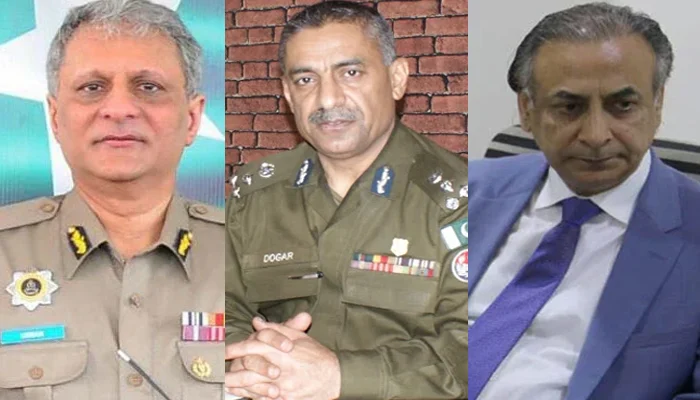
LAHORE: In a major bureaucratic reshuffle, the federal government Monday appointed Zahid Akhtar Zaman as Punjab chief secretary, Usman Anwar as inspector general of police (IGP), and replaced Capital City Police Officer (CCPO) Lahore Ghulam Muhammad Dogar with Bilal Siddique Kamyana, The News reported.

Newly-appointed Chief Secretary Zahid Akhtar Zaman belongs to the 24th Common of Pakistan Civil Services. He has served in multiple key positions in Punjab.

IGP Dr Usman Anwar has replaced recently appointed Amir Zulfiqar Khan. Ahead of the appointment, Usman Anwar was performing his duties as additional IG Motorway Police.

Usman Anwar joined the police force as ASP in 1995 and has a good reputation. Anwar belongs to the 23rd Common of the Pakistan Police Service. He has previously served as additional IG special branch in Punjab, SSP operations Faisalabad, in crime investigation department (CID) and as chief traffic officer Rawalpindi.

Usman has also served as DPO Okara, DPO Sargodha, and in Telecommunication and Elite Police. He has also held important positions in Punjab, Sindh and Islamabad police.

Meanwhile, the government has replaced Capital City Police Officer (CCPO) Lahore Ghulam Muhammad Dogar with Additional IG Bilal Siddique Kamyana. Dogar has been directed to report to the Establishment Division.

Dogar was the head of the joint investigation team (JIT) formed to investigate the attack on the Pakistan Tehreek-e-Insaf (PTI) long march in Wazirabad.

Sources in Punjab bureaucracy predict more changes in Punjab’s bureaucracy after caretaker CM Mohsin Naqvi was sworn in.

JIT reconstituted

Following the allegation levelled by members of the joint investigation team (JIT) on its head and CCPO Ghulam Mahmood Dogar, the probe body was reconstituted once again on Sunday.

The development came after differences emerged between Dogar and the other four members of the JIT. The four members of the probe body were replaced after they raised objections against Dogar’s ‘politically inclined’ conduct.

Advocate Mian Dawood, the counsel of the suspect involved in the gun attack on Imran Khan, argued that Ghulam Mahmood Dogar was probing the case as per the will of the PTI leader.

“The nation already considers Ghulam Mehmood Dogar responsible for botching the investigation of the case,” he added.

However, on Monday, the federal government formed a separate joint investigation team (JIT) to probe the alleged assassination attempt.

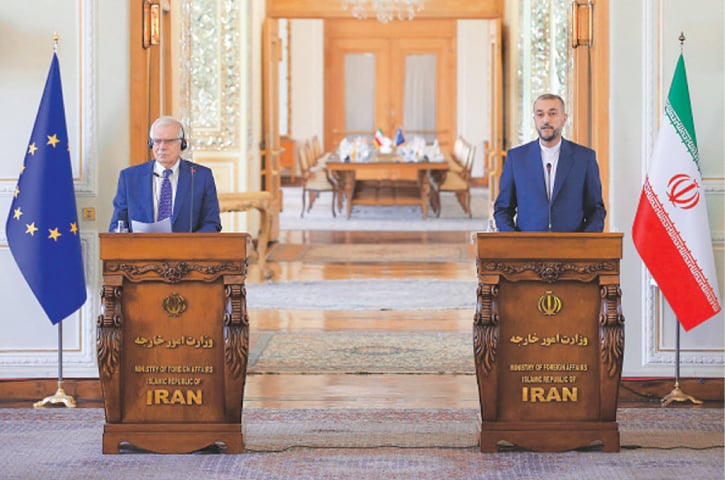
EU, UK and US impose new sanctions on Tehran over protests

Separately, the United States on Monday imposed sanctions on Iran’s Islamic Revolutionary Guard Corps Cooperative Found­ation and senior Iranian officials, stepping up pressure on Tehran over its crackdown on protests.

Iran’s ties with the West have long been tense, over issues ranging from its contentious nuclear programme to its role in regional conflicts and the detentions of foreigners and dual nationals.

But ties have taken a turn for the worse as Iran has moved against what it labels “riots” sparked by the death of Mahsa Amini, 22, after her arrest for allegedly breaching Iran’s dress code for women.

Tehran has been infuriated by what it considers the tough stance taken by Britain, France and Ger­many, and accused Western powers of “inciting the protests and riots”.

The EU on Monday launched its fourth round of sanctions against Tehran since the protests started, placing 37 more Iranian officials and entities on an asset-freeze and visa-ban blacklist.

Britain on the same day sanctioned five more Iranian officials, broadening its list to 50 targeted Iranian individuals and organisations.

The 27-nation EU has so far, however, stopped short of blacklisting Iran’s Islamic Revolutionary Guard Corps as a terrorist group, despite calls from Germany and the Netherlands to do so.

Iran has warned the bloc against such a step, and some EU officials are wary that it could kill off stalled attempts to revive the 2015 deal on Tehran’s nuclear programme.

EU foreign policy chief Josep Borrell insisted there needed first to be a legal ruling in an EU member state before the bloc could make the move.

Several European countries are also mobilising to obtain the release of their nationals detained in Iran, some held on spying charges.

Belgium and France, which both have citizens behind bars in Iran, on Monday denounced what they labelled Iran’s “policy of hostage taking”.

Western countries have also accused Iran of supplying armed drones to Russia specifically for use in the war in Ukraine, a claim Tehran has denied.

The view from Iran

Tehran has been angered by Europe’s strong criticism since the start of the protest movement sparked by the death of Iranian Kurd Amini.

The Islamic republic’s senior officials on Sunday accused the Euro­peans of waging “a hybrid war against the Iranian nation” on psychological, media and economic fronts.

Germany has also “adopted tough and radical positions against Iran”, according to Fayaz Zahed, an Iranian professor of international relations at Islamic Azad University in Tehran. This stood in contrast with the days when Angela Merkel was chancellor and Berlin was a pillar of maintaining dialogue with Tehran, he said.

“The issue of Iran has become central in Western public opinion so that it has become difficult for governments to normalise their relations with Tehran,” he argued.

Iranian foreign ministry spokesman Nasser Kanani charged that “some European countries, inclu­ding Germany, have chosen the path of provocation to incite the protests and riots” in order to “stir up instability” in Iran.

Iran’s top diplomat Hossein Amir-Abdollahian on Sunday contrasted the stance of its longtime arch foe the United States with what it considers a more hostile position taken by Britain, France and Germany.

Can the crisis get worse?

Iranian political analyst and broadcast journalist Abbas Aslani predicted the EU will back off a terror listing for the Guards because “it risks opening another crisis, in particular in the field of energy, in the midst of the war in Ukraine”.

Talks have been stalled for many months, meanwhile, on reviving the frayed nuclear deal under which Iran was promised sanctions relief in return for limits on its nuclear programme.