
Turkey’s president has restated his opposition to Finland and Sweden joining Nato – just hours after they said they would seek membership.

Recep Tayyip Erdogan said the two Scandinavian nations need not send delegations to convince Turkey, a key Nato member, of their bids.

He is angered by what he sees as their willingness to host Kurdish militants.

Earlier, Sweden said Europe was living in a dangerous new reality, referring to Russia’s invasion of Ukraine.

Russian President Vladimir Putin said the move by Finland and Sweden to join the 30-member military alliance did not threaten Moscow directly – but stressed that any expansion of military infrastructure would trigger a response from the Kremlin.


At a news conference on Monday, Mr Erdogan said Turkey opposed the Finnish and the Swedish bids to join Nato, describing Sweden as a “hatchery” for terrorist organisations.

“Neither of these countries have a clear, open attitude towards terrorist organisation. How can we trust them?” the Turkish president said.

Turkey accuses the two Nordic nations of harbouring members of the Kurdistan Workers’ Party (PKK), a group it views as a terrorist organisation, and followers of Fethullah Gulen, who Ankara accuses of orchestrating a 2016 coup attempt.

All member states must agree that a new country can join Nato, therefore Sweden and Finland require Turkey’s support in their bid to join the military alliance.

Mr Erdogan said Swedish and Finnish delegations should not bother going to Ankara, Turkey’s capital, to convince it to approve their Nato bid.

His government has also pledged to block applications from countries that have imposed sanctions on it.

In 2019, both Nordic nations slapped an arms embargo on Ankara after its incursion into Syria.

Speaking in parliament in Helsinki on Monday, Finnish Foreign Minister Pekka Haavisto said he was surprised by Turkey’s stance, but added that his government was not interested in “bargaining” with Mr Erdogan.

Finland formally announced its bid to join Nato last week.

It was joined by neighbour Sweden on Saturday in a move that will end the Scandinavian country’s centuries-long military non-alignment.

“Nato will strengthen Sweden, Sweden will strengthen Nato,” Prime Minister Magdalena Andersson said at a briefing on Monday.

She said Europe was now living in a dangerous new reality, referring to Russia’s invasion of Ukraine.

“We are leaving one era behind us and entering a new one,” Ms Andersson told lawmakers during a debate in Stockholm, also on Monday.

She said a formal application could be handed within several days and would be synchronised with Finland. Nato has signalled its willingness to admit the two new members.

However, Ms Andersson stressed that Sweden did not want permanent Nato bases or nuclear weapons on its territory.

Norway, Denmark and Iceland – all Nato members – immediately said they were ready to support Sweden and Finland by all means necessary if they came under attack.

Monday’s announcement by Sweden came as Nato began one of its biggest exercises in the Baltic region, involving some 15,000 troops. Named “Hedgehog”, the drills in Estonia involve 10 countries, including Finland and Sweden.

For Finland and Sweden to join Nato, all 30 existing members must say yes. But for now, one is saying no.

President Erdogan says he won’t agree to admit countries which apply sanctions on Turkey.

Sweden suspended arms sales to Turkey three years ago, following Ankara’s military intervention in Syria. And according to the official Turkish news agency, both Finland and Sweden have rejected dozens of requests to extradite Kurdish militants who Turkey describes as terrorists.

Both countries are sending delegations to Ankara to try and solve the problem, but President Erdogan says they shouldn’t bother.

He seems determined to extract a price for his precious vote.

On Sunday, the US Secretary of State, Antony Blinken, said he was confident that Finland and Sweden would both join, despite Turkish objections.

The issue is likely to dominate discussions between Mr Blinken and his Turkish opposite number in Washington on Wednesday. Having encouraged the two Nordic countries to apply, Washington won’t want to let them down at the 11th hour.

The government’s decision to delay parts of its obesity strategy is “morally reprehensible”, former Conservative Party leader Lord Hague has said.

Curbs on multi-buy deals in shops and on TV adverts for junk food have been put on hold for at least a year.

Ministers said the delay would give them time to assess the impact of the plans on the cost of living crisis.

But Lord Hague said that argument was “baseless”.

Writing in the Times, he said the government was “intellectually shallow” and “politically weak” for giving in to Tory MPs who had been critical of the strategy.

“Many Tories object to the ‘nanny state’ image of anti-obesity policies and think it is ‘un-Conservative’ to pursue them,” he said.

“As a former Tory leader, I emphatically disagree with this interpretation of conservatism.

“Conservatives support freedom of choice but have always seen that it is sometimes necessary to prevent consumers being abused or misled.”


Last week, ministers announced that the planned ban on “buy one get one free” (Bogof) deals for food and drinks high in fat, salt or sugar, as well as free refills for soft drinks, would be pushed back.

Plans to restrict TV advertising of junk foods before the 21:00 GMT watershed and paid-for online adverts were also paused. They will not come into force until January 2024.

But restrictions on where stores can display food high in sugar or far will still go ahead in October.

Former cabinet minister Lord Hague said the government’s “U-turn” adds to a “long history of failed obesity strategies”.

“It means the current government’s anti-obesity drive will probably join the 14 strategies and 689 different policies over the past 30 years, according to a Cambridge University study, that have failed to deliver,” he said.

How common is obesity?

  • Around two in three adults in England were overweight or obese, according to an NHS health survey in 2019. Almost three in 10 are considered to be obese.
  • Among children aged four to five, 14% are obese, with a further 13% overweight, the another report found last year.
  • In children aged 10 to 11, this rose to 26% obese and 15% overweight.
  • These figures showed large increases on the previous year, when almost 10% of children aged four to five and 21% of children aged 10-11 were obese.

Lord Hague said those who had pressed for the dilution of the obesity strategy were “profoundly mistaken”.

“They are acquiescing in a future of higher dependence, greater costs, reduced lifestyle choice and endless pain.

“For the government to give in to them is intellectually shallow, politically weak and morally reprehensible.”

Health campaigners have also criticised the delay, with chef Jamie Oliver saying it was a “wasted opportunity” which “looked progressive and world leading written down, but is falling apart”.

Lord Hague – who served as Conservative Party leader from 1997 to 2001 – said food companies had an “overwhelming incentive” to design products that led people down a “chemically induced addiction to foods”.

“We should be able to focus resources on those who are unavoidably ill and disabled.

“Covid hit us harder because of widespread obesity. If we fail to control diet-related diseases, on top of paying for an ageing population, there will be no possibility of lower taxes in the future,” he said.

Panorama on Obesity: Who Cares if I’m Bigger?

Eighteen months after the prime minister launched his strategy to help the nation lose weight, EastEnders actress Clair Norris, who is overweight herself, wants to know if it is working.

Some of the poorest households in England and Wales are struggling to access council tax rebates to help offset their soaring energy bills, a charity has warned.

National Energy Action said those who did not pay council tax by direct debit were affected, with many facing long waits for the £150 payouts.

Councils say they are struggling to administer the rebates at short notice.

But the government said they should make the payouts without further delay.

Councils were expected to start paying the £150 rebates from April, when the energy price cap went up by £693 for the average household, leaving many struggling to pay their bills.

All rebates must be paid by September, the government says.

However, the BBC looked at the websites of the 331 billing authorities in England and Wales responsible for administering the rebates and found a clear split in timings of payments for those who pay their council tax by direct debit and those who do not.

This is because direct debit payments are far easier to process, due to local authorities already having the name and banking details of the household.

‘Serious concerns’

The problem, says National Energy Action, is that it is typically the poorest households that do not pay council tax by direct debit – either because they do not have a bank account or because they manage their finances on a more ad hoc basis.

“There are serious concerns that those with the greatest need will be least able to access the money,” said chief executive Adam Scorer.

Chris O’Keefe and his friend John worry it will be hard to access the rebate

As of the end of May, more than 280 English and Welsh councils said payments should have been made directly into people’s bank accounts.

However, the vast majority of councils said customers who did not pay by direct debt were likely to be contacted over the coming weeks, by email or by post, and urged to make an application online or over the telephone.

Only 15 councils said they were already mailing out Post Office vouchers to non-direct debit households for them to exchange for cash.

‘It’s unfair’

The Lighthouse Project is a community hub set up to tackle poverty in Middleton, Greater Manchester. At its weekly coffee morning at the local shopping centre, there was a lot of confusion about the rebate.

The town sits under Rochdale Borough Council, where over a third of residents do not pay council tax by direct debit.

“I think it’s unfair,” said Chris O’Keefe who pays his council tax weekly. “Just because you don’t pay by direct debit, it shouldn’t mean you’re not a priority. We should all be treated the same.”

Chris and his friend John, who was sat next to him, both live with a disability and say that keeping on top of their entitlements through the council’s website or over the phone is already pretty tricky. Accessing the rebate is likely to be hard, they think.

Carole Mboe did not know about the rebate at all

Carole Mboe did not know about the rebate at all and worried that many people would not know how to apply online. “Many people just do not have the computer skills,” she said.

Lianne Walker has learning difficulties and would struggle with a letter from the council. “Either I’d get my neighbour to read it for me or I’d take it to my sister,” she said. “I’d be paranoid and all stressed and I might burst out crying.”

But 90-year-old Rosemary Donnelly has already received her payment because she pays by direct debit, and has been telling her friends at the local lunch club to look out for it.

“£150 will make a lot of difference, because to some people it’s an awful lot of money,” she said.

‘Getting our skates on’

Rochdale Borough Council is processing 50,000 direct debit rebates and has just started to mail out letters to the other 30,000 locals who won’t be paid automatically. Neil Emmott, who leads the council, said central government probably did not understand how complicated the process would be in many areas.

“I think governments sat in London don’t always necessarily know what’s taking place,” he said. “It’s not fair, but give me an alternative way to do this?”

He added: “The most vulnerable need this payment, and we are getting our skates on to get payments to those people as soon as possible.”

But other councils have found it more straightforward.

The £150 energy rebate was a flagship government announcement. Rather than target help to the most vulnerable they decided to give free money to the vast majority of households to help them cover the energy price cap rise.

But no-one had this money in their account on 1 April when energy prices went up for most households. 331 different billing authorities had to work out a way to get the money to us, resulting in a postcode lottery between authorities.

For most councils in England and Wales it’s taking a few months to get the money to those who pay by direct debit, and it’s now a much longer wait for those who pay council tax in another way, or are exempt from council tax altogether.

The most vulnerable are only now being contacted, and a process which puts the onus on them to apply online or get in touch with bank details is only just beginning. Meanwhile the higher bills have had to be paid, or the meter topped up, with none of the extra cash the government promised.

line

Just 90 miles away in Shropshire, Telford and Wrekin Council has already processed 95% of its rebates, regardless of how residents pay their council tax bill.

Cllr Rae Evans, who leads on finance and customer service in the area, said the council’s experience of handling grant funding during the pandemic had helped it get on the front foot by investing in its website and app and pushing residents to pay by direct debit.

“We are immensely aware of the financial pressures that our residents and businesses are under,” she said. “We could see this coming earlier in the year, so it was thinking ahead that allowed us to be in the right place at the right time.”

Chancellor Rishi Sunak announced the energy rebate scheme in February

Payment systems for the rebate vary across the nations of the UK.

The BBC contacted 32 billing authorities in Scotland. 25 responded to confirm that the £150 is not rebated but instead credited onto the council tax bill, making monthly payments lower for the forthcoming financial year. Those exempt from paying council tax in Scotland can apply for a cheque.

The government in Northern Ireland has received a proportionate amount of money which will go into their central funds.

‘Not without challenges’

The Local Government Association, which represents councils in England, said the rebate has been “a significant task and not without its challenges”.

“Many residents who are signed up to direct debit will have already started to receive their rebate,” a spokesperson said. “Some councils have begun making payments this month to allow software to be fully tested and to ensure April direct debit payments are not recalled and many are now also focusing on contacting those eligible who do not pay their council tax by direct debit.”

The LGA added that many local authorities had additional schemes in place for locals struggling with their energy bills.

A spokesperson for the Department for Levelling Up, Housing and Communities said they expected local councils to start making payments without further delay.

“Direct debit is the quickest and easiest way to pay council tax, and the best way for most people to get the rebate. But councils have a range of options for people who don’t pay by direct debit.”

A Treasury spokesperson said the country has had a “strong economic recovery” from the pandemic but acknowledged that these are “anxious times”, and said the government is taking action to support households.

“This includes a tax cut of over £330 a year for the typical employee, lowering the Universal Credit taper rate to help people keep more of the money they earn, and providing millions of households with up to £350 each to help with rising energy bills,” the spokesperson said.

“Public debt is at the highest levels since the 1960s and rising inflation is pushing up our debt interest costs, which means we must manage public finances sustainably to avoid saddling future generations with further debt.”

Palestinians mourn Israel’s creation amid outcry over funeral raid

The annual demonstrations across the occupied West Bank, annexed east Jerusalem and inside Israel came with tensions high over the killing of 51-year-old Al Jazeera reporter Shireen Abu Akleh.

The Palestinian-American was shot dead by Israeli security forces on Wednesday during an Israeli raid in Jenin, a West Bank flashpoint. A Palestinian militant wounded in clashes there, Daoud al-Zubaidi, died from his injuries in an Israeli hospital on Sunday.

Israeli police have vowed to investigate the chaos that marred the day of Abu Akleh’s funeral, after television footage seen worldwide showed pallbearers struggling to stop the casket from falling to the ground as baton-wielding Israeli police descended upon them, grabbing Palestinian flags.

The scenes on Friday sparked international condemnation, including from the United States, United Nations and the European Union, with US Secretary of State Antony Blinken on Sunday calling for a “credible” investigation into Abu Akleh’s death as he offered condolences to her family.

Late South African Archbishop Desmond Tutu’s foundation said Israeli police “attacking pallbearers” was “chillingly reminiscent of the brutality” seen at the funerals of anti-apartheid activists.

Israeli commentators joined the chorus lambasting the raid as Abu Akleh’s coffin emerged a Jerusalem hospital.

In leading Israeli daily Yediot Ahronot, Oded Shalom said the footage “documented a shocking display of unbridled brutality and violence”.

“The Jerusalem District Police decided to come down like a tonne of bricks on anyone who dared to hold a Palestinian flag,” Shalom wrote.

“As if holding up a flag — a mere piece of cloth, for God’s sake — at a funeral procession for an hour or two could have had any impact whatsoever” on Israeli claims to control over Jerusalem, he added.

Israeli police regularly crack down on people holding Palestinian flags.

Gaza crossing reopened

Israel reopened on Sunday its only crossing with the Gaza Strip to Palestinian workers nearly two weeks after closing it over unrest, the defence ministry said.

“Following an assessment of the security situation, it has been decided to open Erez Crossing for passage of workers and permit holders from the Gaza Strip into Israel, beginning on Sunday,” said COGAT, a unit of the Israeli defence ministry responsible for Palestinian civil affairs.

N. Korea reports 15 ‘fever’ deaths amid Covid outbreak

The outbreak, which leader Kim Jong Un has said is causing “great upheaval”, leaves a country with one of the world’s worst healthcare systems on the edge of potential disaster.

North Korea has no Covid vaccines, antiviral treatment drugs or mass-testing capacity.

While it has maintained a rigid coronavirus blockade since the pandemic’s start, experts have said that massive Omicron outbreaks in neighbouring countries meant it was only a matter of time before Covid snuck in.

Despite activating a “maximum emergency quarantine system” to slow the disease’s spread through its unvaccinated population, Pyongyang is now reporting large numbers of new cases daily.

Official state media KCNA on Sunday said 42 people had died since the outbreak’s beginning, with 820,620 cases and at least 324,550 receiving medical treatment.

The news agency reported that “all provinces, cities and counties of the country have been totally locked down and working units, production units and residential units closed from each other.” North Korea first revealed the highly contagious Omicron variant had been detected in the capital on Thursday, with Kim ordering nationwide lockdowns after an emergency meeting of the country’s Politburo.

“The spread of malignant disease comes to be a great upheaval in our country,” Kim said Saturday.A large number of the deaths have been due to “a lack of knowledge and understanding of the stealth Omicron variant virus infection”, KCNA said, adding “urgent” measures were being being taken to educate the public.

Sunday’s KCNA report did not specify whether the new cases and deaths tested positive for Covid-19, but experts say the country will struggle to screen and diagnose on a massive scale.

North Korea’s healthcare system ranked 193 out of 195 countries in a 2021 Johns Hopkins University survey. “With the current very backward and inaccurate testing method — which diagnoses Covid-19 based on whether a person has a fever or not — it’s impossible for North Korea to detect asymptomatic infections and contain the outbreak,” said Cheong Seong-jang, a researcher at the Sejong Institute.

“With the continued spike in the number of Covid-19 infections, the number of deaths from it is expected to rise further,” he added.

Kim has said the country will “actively learn” from China’s pandemic management strategy, according to KCNA.

China, the world’s only major economy still maintaining a zero-Covid policy, is battling multiple Omicron outbreaks — with lockdowns in some major cities, including financial hub Shanghai, sparking increasing public frustration.

Curfew lifted in Sri Lanka for Buddhist festival

A countrywide stay-home order has been in place for most of the week after mob violence left nine dead and over 225 wounded, sparked by attacks on peaceful demonstrators by government loyalists.

Protesters across the Buddhist-majority nation have for weeks demanded the resignation of President Gotabaya Rajapaksa over Sri Lanka’s worst-ever economic crisis.

Shortages of food, fuel and medicines, along with record inflation and lengthy blackouts, have brought severe hardships to the country’s 22 million people.

Sunday marks Vesak, the most important religious event on Sri Lanka’s calendar, which celebrates Buddha’s birth, enlightenment and death.

The government has declared a two-day holiday and announced it was lifting the curfew for the day without saying when or whether it would be reimposed.

But the ongoing crisis prompted the government to cancel its plans to celebrate the festival, which had been scheduled at a temple in the island’s south.

“Given the economic situation of the government and other constraints, we are not having this year’s state festival at the Kuragala temple as planned,” a Buddhist Affairs ministry official said. The official said Buddhists were free to hold their own celebrations, including the mass meditation and Buddhist sermons traditionally organised during the festival.

Worshippers usually set up soup kitchens, lanterns and “pandal” bamboo stages bearing large paintings depicting stories from Buddha’s life.

But Sri Lanka has been unable to properly stage Vesak for years, with the Easter Sunday attacks dampening celebrations in 2019 and the last two years affected by the coronavirus pandemic.

“Everybody knows that it is Lord Buddha’s special day today,” said Chamila Perera, a housewife in the capital Colombo.

“We are hoping good things will happen,” she said. “But I’m feeling very sad.” Newly appointed Prime Minister Ranil Wickremesinghe is struggling to form a unity government ahead of Tuesday’s parliamentary session, the first since he took office. Opposition leader Sajith Premadasa has already formally rejected an overture to join the new administration.

“The demand from the streets is that President Rajapaksa should step down,” Premadasa said. “We will not join any government with him in it.” But he added that his party would not block legitimate “solutions to the economic problems” in parliament.

Rajapaksa on Saturday appointed four new ministers, all from his own Sri Lanka Podujana Peramuna (SLPP) party, but the all-important finance ministry remains vacant.

Official sources said the new prime minister could take the finance portfolio to spearhead ongoing negotiations with the International Monetary Fund for an urgent bailout.

Wickremesinghe, a veteran politician who was sworn in as prime minister for a sixth time on Thursday, has already met with diplomats from Britain, the United States, Japan, China and India to seek financial aid.

US Senator Chris Murphy stresses need for expansion of ties with Pakistan

Senator Chris Murphy, who chairs the Senate Subcommittee on Near East, South Asia, Central Asia, and Counterterrorism, said the two nations should stay engaged with each other in both good and bad times.

“As with every bilateral relationship, there are ups and downs but this one has endured the test of time and I look forward to continuing to grow it for the next 75 years,” he said in a special message on the 75th anniversary of diplomatic ties between the United States and Pakistan.

Pakistan’s US Ambassador Sardar Masood Khan appreciated Senator Murphy’s gesture, noting that he was a true friend of Pakistan on the Hill and a strong advocate of closer US-Pakistan ties.

“This relationship will bounce back with economic content at the centre,” the ambassador added.

Senator Murphy pointed out that Pak-US relations were ‘incredibly important’ and this importance was recognised by the Senate as well. Highlighting the contributions of the US towards socio-economic development of Pakistan, Senator Murphy said that “we have devoted significant resources through USAID projects to build up Pakistani democracy and to work together on joint security projects”.

World leaders pay respects to pro-West UAE president

Sheikh Mohammed, now ruler of wealthy Abu Dhabi emirate, steered the Western-allied Gulf state, an OPEC oil producer and regional business hub, for years before being named the UAE’s third president by a federal supreme council on Saturday.

French President Emmanuel Macron, whose country holds lucrative business and military ties with the UAE, told Sheikh Mohammed in Abu Dhabi that the UAE could “count on France’s friendship” and discussed the Ukraine conflict, the Elysee said.

Israeli President Isaac Herzog said before heading to the Emirati capital that the establishment of ties between the UAE and Israel two years ago was an asset for the whole region built by “bold and groundbreaking leaders”, including Khalifa.

The UAE, along with Bahrain, upended decades of Arab consensus by forging relations with Israel, creating a new anti-Iran axis in the region and drawing Palestinian ire. The Palestinian president was also due in Abu Dhabi on Sunday as was Britain’s prime minister.

US President Joe Biden, whose administration has had fraught ties with the UAE and Saudi Arabia, will be represented by Vice President Kamala Harris, due to visit on Monday.

Several Arab leaders paid respects on Saturday. Saudi Arabia’s crown prince, whose father King Salman entered hospital a week ago, sent a delegation.

Sheikh Mohammed, known as MbZ, has been a driving force in Middle East politics, championing Saudi Crown Prince Mohammed bin Salman in the West as he rose to power and combating political Islam, seen as a threat to Gulf dynastic rule, around the region.

Crisis-hit Sri Lanka set for uneasy ‘economic war cabinet’

Protestors remained camped outside President Gotabaya Rajapaksa’s residence demanding that he resign meanwhile, as troops continued to patrol the streets while ordinary Sri Lankans queued up for scarce supplies.

Ranil Wickremesinghe, appointed prime minister for a sixth time on Thursday, has struggled to form a “unity government” after the main opposition insisted that Rajapaksa should follow his brother Mahinda who quit as premier last week.

However, two stalwarts from the main Samagi Jana Balawegaya (SJB) opposition party agreed to break ranks and join an “economic war cabinet”, party sources told AFP.

Opposition leader Sajith Premadasa said his party would not block in parliament any legitimate “solutions to the economic problems”.

Another opposition group, the Sri Lanka Freedom Party (SLFP), said they will also offer conditional support to Wickremesinghe, overturning their earlier decision not to.

“We will support any correct decisions taken by the new government to address our grave economic crisis,” SLFP leader Maithripala Sirisena said in a letter to the premier.

Official sources said the full cabinet was likely to be sworn in ahead of Tuesday’s parliamentary session, the first since 73-year-old Wickremesinghe’s appointment.

Four ministers were sworn in on Saturday, all from Rajapaksa’s Sri Lanka Podu Jana Peramuna (SLPP) party.

However, there is no finance minister yet, and it is widely expected that the prime minister will retain the crucial portfolio to lead ongoing negotiations with the IMF for an urgent bailout.

Wickremesinghe has also called for international support.

He held talks on Sunday with World Bank and Asian Development Bank representatives in Colombo focusing on the issues facing the supply of medicines, food, fuel and fertiliser, his office said in a statement.

“While explaining that discussions have been positive, the prime minister stated that the government is facing the immediate challenge of securing funds to pay for the fuel requirement for this coming week,” the statement said.

“Due to the dollar shortages in the banks, the government is now exploring other options of securing the necessary funding.”

Shortages of food, fuel and medicines, along with record inflation and lengthy blackouts, have brought severe hardships to the country’s 22 million people.


Protesters across the Buddhist-majority nation have for weeks demanded the resignation of President Rajapaksa over Sri Lanka’s worst economic crisis since independence in 1948.

The appointment of Wickremesinghe has so far failed to quell public anger at the government for bringing Sri Lanka to the brink of economic collapse.

Thousands continue to protest outside the president’s sea-front office demanding his resignation where they have been since April 9.

Long queues stretched outside the few fuel stations that were still open on Monday, a Buddhist holiday, as motorists waited for rationed petrol.

Heavily armed troops were still patrolling the streets with a state of emergency still in effect after at least nine people were killed in violence last week.

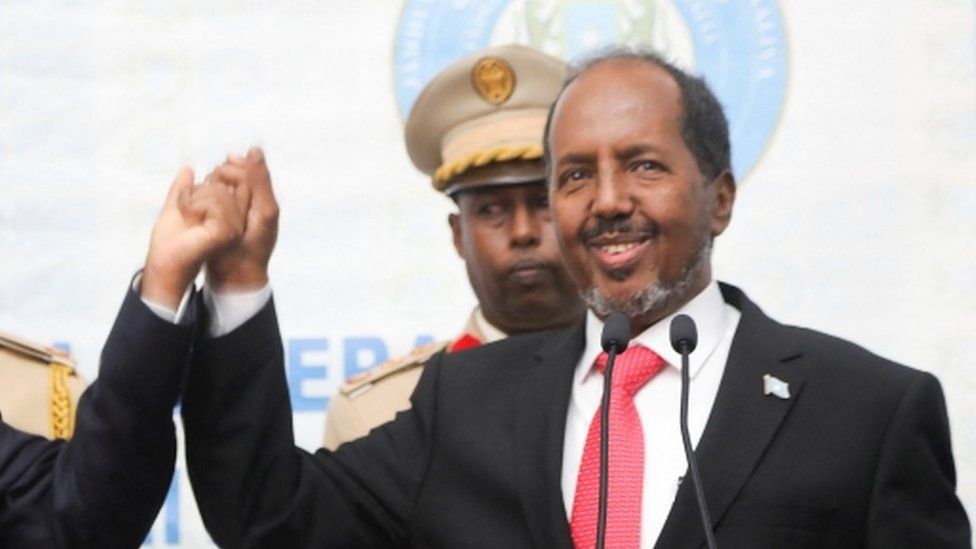
Somalia’s former leader Hassan Sheikh Mohamud has been elected president after a final vote that was only open to the country’s MPs.

He defeated the current president, Mohamed Abudallahi Farmajo, who has been in office since 2017.

The ballot was limited to Somalia’s 328 MPs due to security concerns over holding a wider election, and one of them did not cast a vote.

Mr Mohamud received 214 votes, defeating Mr Farmajo who won 110 votes.

Three MPs are reported to have spoiled their ballots.

The unusual circumstances highlight Somalia’s security issues as well as the lack of democratic accountability.

The result marks a comeback for Hassan Sheikh Mohamud, who served as Somalia’s president between 2012 and 2017 before he was defeated by Mr Farmajo.

The elections – which were hotly contested and went to a third round – were delayed for almost 15 months due to infighting and security issues.

Mr Mohamud was sworn in shortly after the final results were announced, prompting supporters in the capital to cheer and fire guns into the air. He will serve for the next four years.

In the vote on Sunday, hundreds of parliamentarians cast their ballots at a fortified aircraft hangar in the capital Mogadishu.

Explosions could be heard nearby as voting was taking place, but police said no casualties were reported.

As the incoming president, Mr Mohamud will have to deal with the impact of an ongoing drought in which the UN says 3.5 million Somalis are at risk of severe famine.

But the big task he faces is to wrest control of much of Somalia from al-Shabab. The al-Qaeda-linked Islamist militant group continues to dominate large parts of the country and carries out frequent attacks in Mogadishu and elsewhere.

The country is also being affected by food and fuel inflation sparked by the war in Ukraine.

Why Somalia’s election matters

The government is backed in its fight against al-Shabab by the African Union, in the shape of some 18,000 troops and the United Nations.

The instability is one of the reasons why Somalia has been unable to hold direct elections. Somalia has not had a one-person-one-vote democratic election since 1969.

That vote was followed by a coup, dictatorship and conflict involving clan militias and Islamist extremists.

This is only the third time that the indirect election for president has been able to take place in Somalia itself. Previous ones were held in neighbouring Kenya and Djibouti.

How did the voting work?

Voting took place in an airport hangar on Sunday

This vote was supposed to have happened last year when Mr Farmajo’s four-year term ended. But political differences and instability delayed the poll and the president remained in power.

The MPs who chose the new president were themselves elected by delegates nominated by the country’s powerful clans.

They gathered in a large airport hangar in the well-guarded Halane Camp. This is the main military base of the AU’s mission in Somalia (Atmis), as well as the home of diplomatic missions and aid agencies.

The voting, done by secret ballot, was delayed for hours due to lengthy security checks.

Past elections were marred by allegations of vote-buying with candidates reportedly offering money in exchange for support.

The only female candidate, former Foreign Minister Fawzia Yusuf Adam, was eliminated in the first round of voting.

What has al-Shabab said?

In previous elections, al-Shabab threatened and even kidnapped clan elders after condemning them for participating in what it saw as an un-Islamic poll.

This time around, its response to the elections has been more muted, with fears that its members or sympathisers may have secretly sought parliamentary seats in a bid to undermine the system from within.

The fear was publicly expressed by neighbouring Djibouti’s President Omar Guelleh in 2020, when he was quoted as saying: “I fear we will end up with a parliament indirectly controlled by al-Shabab because they’ll have bought the support of some of the MPs.”

Some analysts felt Mr Guelleh was exaggerating the possibility of al-Shabab gaining a foothold in parliament, but there is no doubt that it is a major political force in Somalia.